- Categories:
- Health
- Tags:
- AwarenessLifestyle
- Where:
- United States
- Date change rule:
- Every October 9
Presented by:

National C60 Day, created by C60 Power, explores Carbon 60 every October 9. Also known as buckminsterfullerene or a buckyball, C60 is a hollow molecule made from 60 carbon atoms that works as a ¨free radical sponge¨ with the ability to neutralize free radicals and reset itself. Not only can C60 help maximize the efficiency of the cells in producing energy, but it may also provide cellular protection against toxic environmental factors. The day is a chance to learn how C60 was discovered, read about the benefits it offers humans and animals, and uncover more about this fascinating molecule.
Expected National C60 Day Deals

National C60 Day Sale
Save 20% storewide on C60 Power products, from C60 oils and gummies, to skincare, and C60 for pets.
This special offer is valid on October 9 at ShopC60.com.
Use the code CELEBRATE20 for 20% off at checkout.
Ready to try C60 after National C60 Day?
Visit Shopc60.com and use the code NATIONAL10 for 10% off your first order.
Platform Guide for National C60 Day
Use a clean carousel with one idea per slide: What is C60? Why is it called a buckyball? When was it discovered? What are scientists studying now? What are the benefits of C60? Finish with the October 9 date and #NationalC60Day. Tag @nationaltoday_ when sharing the holiday.
TikTok
Lead with the strange part of the story: C60 was discovered in an experiment designed to recreate the chemistry around carbon-rich stars. Use a simple animation, molecule model, or product-in-use shot, then explain the 60-carbon structure and benefits in plain English. Tag @www.nationaltoday.com and use #NationalC60Day.
YouTube
Build a short educational video around the question “What is C60?” Cover the 1985 discovery, the 1996 Nobel Prize, the molecule’s structure, and the modern research areas connected to fullerenes, including the studies on C60 and healthy aging.
National C60 Day Hero
Sir Harold Kroto
History of National C60 Day
Carbon 60, or C60, belongs to a family of carbon structures called fullerenes. Its most familiar nickname, buckyball, comes from its hollow, cage-like shape. With 60 carbon atoms arranged in a highly symmetrical structure, the molecule resembles a soccer ball and echoes the geodesic domes associated with architect and inventor R. Buckminster Fuller. The formal name buckminsterfullerene honors Fuller.
The idea came before the proof. In 1970, Japanese chemist Eiji Osawa proposed that a stable, soccer-ball-shaped molecule of 60 carbon atoms could exist, reasoning from symmetry alone. His paper was published in Japanese and remained little known internationally until after C60 was found in the laboratory.
That discovery came in 1985 at Rice University. Robert Curl, Harold Kroto, Richard Smalley, and their research team used laser vaporization to study carbon clusters formed in an inert gas, in experiments designed to simulate the chemistry of carbon-rich stars. C60 stood out because clusters containing 60 carbon atoms appeared in unusually high abundance and showed a stability that suggested a distinctive closed-shell structure. The discovery was published in Nature and opened the door to a new branch of carbon chemistry.
For several years, scientists continued testing the proposed structure. In 1990, Wolfgang Krätschmer and Donald Huffman developed a method for producing isolable quantities of C60 by striking an arc between graphite rods in a helium atmosphere. That breakthrough made it easier to study the molecule’s chemical and physical properties and helped confirm the buckminsterfullerene structure. Research took off so quickly that the journal Science named buckminsterfullerene its Molecule of the Year for 1991.
On October 9, 1996, the Royal Swedish Academy of Sciences announced that Curl, Kroto, and Smalley would share the Nobel Prize in Chemistry “for their discovery of fullerenes.”
Since then, C60 research has extended into pure chemistry, materials science, nanotechnology, energy research, skincare, and wellness. Its ability to interact with free radicals is one reason C60 continues to attract attention in antioxidant research.
That research took a new turn in 2012, when a French team reported that rats given C60 dissolved in olive oil lived longer than untreated rats, sparking wide interest in C60 and healthy aging. Two later studies in mice did not reproduce the lifespan effect, and its effects on aging in people have not been established, so the question remains open.
The molecule’s link to the stars was confirmed in 2010, when astronomers led by Jan Cami used NASA’s Spitzer Space Telescope to detect C60 in Tc 1, a cloud of gas and dust shed by a dying star. It was the first time buckyballs had been found in space, 25 years after they were first made on Earth.
National C60 Day was created by C60 Power and falls on October 9 to mark the day the Nobel Prize for the discovery of fullerenes was announced. It gives people a yearly reason to revisit the molecule’s unusual origin story and learn how research continues to shape its modern uses.
National C60 Day timeline
Japanese chemist Eiji Osawa proposes that a stable, soccer-ball-shaped molecule of 60 carbon atoms could exist, years before anyone makes one.
A carbon molecule, that would one day revolutionize medicine, was hypothesized to exist by Buckminster Fuller, in 1979.
Researchers at Rice University identify a stable cluster made from 60 carbon atoms while studying carbon vapor in an inert atmosphere.
Wolfgang Krätschmer and Donald Huffman develop a graphite-arc method that produces material quantities of C60 and C70 for further study.
The journal Science names buckminsterfullerene its Molecule of the Year, as fullerene research spreads across chemistry and physics
Robert Curl, Harold Kroto, and Richard Smalley receive the Nobel Prize in Chemistry for discovering fullerenes
Astronomers using NASA's Spitzer Space Telescope detect C60 in the planetary nebula Tc 1, the first confirmed sighting of buckyballs beyond Earth.
offering C60 products made with certified organic oils and 99.99% pure sublimated Carbon 60.
Ken Swartz and Jessica MacNaughton combine forces to bring C60 to the masses. The company later becomes C60 Power.
C60 Power starts offering C60 for Pets as a C60 product line formulated to support the health of animals.
WhatIsC60.org is founded as an educational resource focused on the science and research around Carbon 60
Shopc60.com introduces C60 Tart Cherry Gummies – the first C60 Gummy in the world.
Shopc60.com introduces the first Sugar Free C60 Gummy in the world.
Shopc60.com introduces C60 Anti-Gravity Serum, a transformational anti-aging skincare product.
Shopc60.com introduces C60 Youth Renewal Eye Cream, a one of a kind C60 + copper peptide anti-aging product designed to support delicate skin around the eyes.
Featuring medical doctors and wellness experts discussing their personal and professional observations of outcomes in people and pets who consume and use Carbon 60.
The next generation of discussions with an updated panel of medical doctors regarding the possible health benefits associated with human use and consumption of 99.99% pure, sublimated C60.
C60 Power is featured in the Amazon Prime documentary, “BioHack Yourself”.
This date marks the 40th anniversary of the discovery of Carbon 60 (C60).
C60 Power is featured in the MAHA documentary film series by Jeff Hays Films.
October 2026 marks the 30th anniversary of the Nobel Prize in Chemistry being awarded for the discovery of C60.
How Businesses Can Celebrate National C60 Day
National C60 Day gives health, wellness, science, beauty, and pet brands a useful educational hook. Wellness companies can publish a plain-English guide to what the research on C60 and aging does and does not yet show, host a short Q&A with a scientist, or share the history of the Nobel-recognized fullerene discovery. Retailers can build a C60 education bundle that links each product to a clear explainer. Offices can host a lunch-and-learn where teams dive into the science and research behind C60. Pet brands can explain how C60 products fit into their animal wellness range.
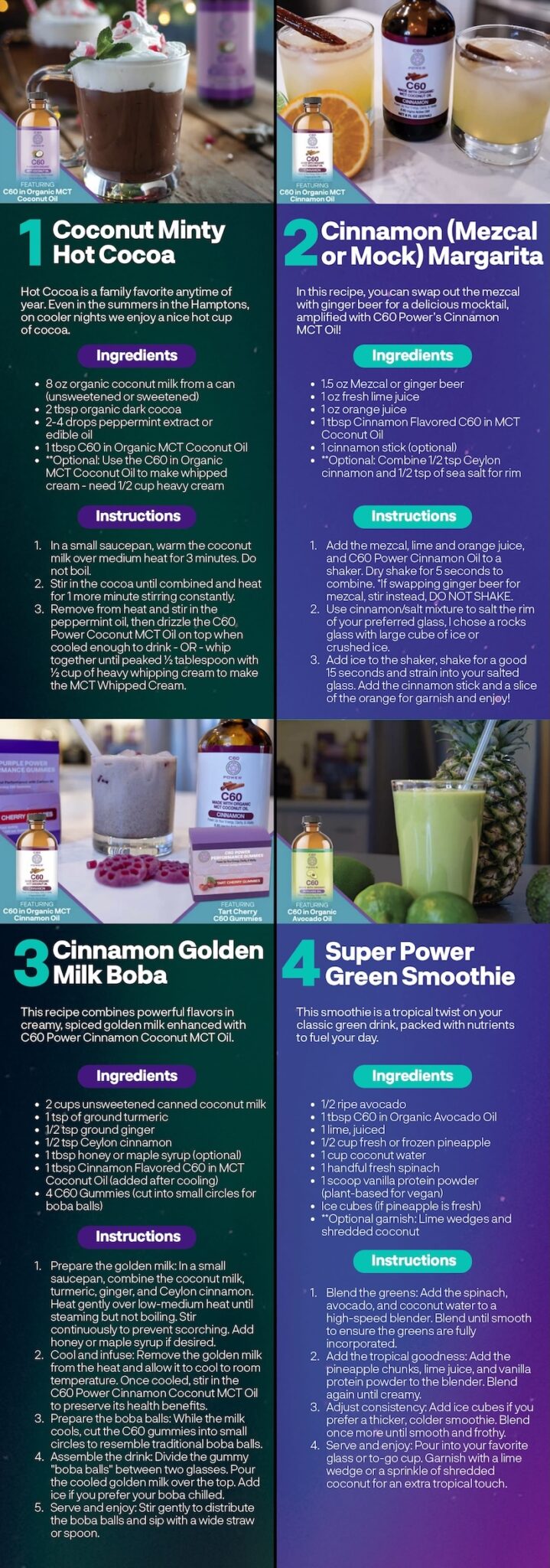
Easy C60 Recipes Guaranteed to Spread Some Cheer!
Why National C60 Day is Important
Not only is C60 a powerful antioxidant, but it also won’t interfere with signaling molecules or medicines, unlike many other antioxidants. C60 only responds to highly charged oxidative radicals such as hydroxyl radicals and superoxide.
Despite its wonderful properties and health benefits, C60 is relatively unknown as it’s a recently discovered molecule. There is also resistance to trying C60 and making it a staple in our lives. Most of this is due to a lack of awareness about the benefits, as well as misconceptions and misinformation surrounding research about C60. National C60 Day informs everyone about the amazing discovery of C60 and its potential benefits.
Interesting C60 Studies
- A 2007 study found that C60 in human mast cells lessened allergic reactions and related inflammation.
- A 2009 human study found that C60 could promote hair growth by combating oxidative damage around the hair follicles.
- In a 2010 human study, C60 was found to protect human skin cells against ultraviolet damage.
- In a 2010 double-blind, human study, it was found that when applied topically, C60 was effective at lessening the appearance of fine lines and wrinkles.
- For more information regarding C60 research, please visit: whatisc60.org
National C60 Day FAQs
When is National C60 Day?
National C60 Day is observed every October 9. The date marks October 9, 1996, when the Nobel Prize in Chemistry for the discovery of fullerenes was announced.
How is the purity of C60 measured?
C60 purity is measured as a percentage, and the difference between 99.9% and 99.99% is significant at the molecular level. That extra 0.09% can represent residual solvents, heavy metals, or carbon byproducts from manufacturing. For a supplement you ingest daily, always look for 99.99%+ purity verified by independent third-party laboratory testing. Industrial-grade C60 (used in electronics and materials science) is typically 99.5% or lower and is absolutely not suitable for human consumption. Be wary of “in-house testing” as much can be skewed or hidden and in-house testing may be likened to counting your votes or grading your own homework.
Does it matter how C60 is processed?
C60 is manufactured through several methods, and most production processes use chemical solvents such as toluene, xylene, or other aromatic hydrocarbons during extraction and purification. Even extensive washing cannot guarantee the complete removal of these solvents from the final product.
Sublimation is an alternative purification process in which solid C60 is heated under vacuum conditions, causing it to transition directly from a solid to a gas (bypassing the liquid phase entirely) and then re-condense as ultra-pure crystals. Sublimated C60 is considered the highest grade available for human use. Its more expensive, time consuming, and few know how to manufacture it.
What is the difference between C60, fullerene, and buckminsterfullerene?
Fullerene is the name for a family of carbon molecules arranged in closed shells. C60 is one specific fullerene made from 60 carbon atoms, while buckminsterfullerene is the formal name for that molecule. Buckyball is its common nickname.
How To Celebrate National C60 Day
Take the C60 Challenge
Start using C60 and see the difference for yourself. You can also keep a journal to log and monitor your C60 intake and its benefits for your health. Download the C60 30-day Challenge Journal here.
Learn why C60 is called a buckyball
Look at a model or illustration of C60 and count the carbon atoms in its structure. Then compare its shape with a soccer ball or a geodesic dome to see why the molecule received the name buckminsterfullerene. The resemblance is exact: C60 and a classic soccer ball share the same pattern of 12 pentagons and 20 hexagons.
Follow the Nobel Prize story
Read the history of the 1985 discovery and the 1996 Nobel Prize in Chemistry. Share the fact that C60 was found during experiments designed to understand carbon clusters connected to stars. Then look up the 2010 Spitzer Space Telescope findings, which showed that buckyballs form naturally in space as well as in the laboratory.
Explore the C60 research library
Start with a plain-English overview. Look for the studies on C60 and aging, and note whether each was carried out in cells, animals, or people. Share one study, question, or new term with #NationalC60Day so someone else can learn alongside you.
Why National C60 Day is Important
It has an extraordinary origin story
C60 was discovered during experiments connected to the chemistry of stars, then named after the geodesic-dome pioneer Buckminster Fuller. Few molecules have a story that moves from astrophysics to a soccer-ball-shaped molecule to modern consumer products.
It makes complex science easier to discuss
The word buckminsterfullerene sounds intimidating until you see the structure. National C60 Day gives people a simple entry point into carbon chemistry, nanotechnology, antioxidant research, and the questions scientists are still exploring.
It sits at the frontier of healthy-aging research
Few molecules have moved so quickly from a physics laboratory into questions about how we age. Researchers are still investigating how C60 interacts with free radicals and what that could mean for long-term health, and the day is a chance to follow that work as it develops. It also encourages people to read the research closely and understand what is inside the products they choose.






Social Media Tips for National C60 Day
Individuals
Creators
Brands