- Today
- Holidays
- Birthdays
- Reminders
- Cities
- Atlanta
- Austin
- Baltimore
- Berwyn
- Beverly Hills
- Birmingham
- Boston
- Brooklyn
- Buffalo
- Charlotte
- Chicago
- Cincinnati
- Cleveland
- Columbus
- Dallas
- Denver
- Detroit
- Fort Worth
- Houston
- Indianapolis
- Knoxville
- Las Vegas
- Los Angeles
- Louisville
- Madison
- Memphis
- Miami
- Milwaukee
- Minneapolis
- Nashville
- New Orleans
- New York
- Omaha
- Orlando
- Philadelphia
- Phoenix
- Pittsburgh
- Portland
- Raleigh
- Richmond
- Rutherford
- Sacramento
- Salt Lake City
- San Antonio
- San Diego
- San Francisco
- San Jose
- Seattle
- Tampa
- Tucson
- Washington
IonQ Achieves Milestone in Networked Quantum Computing
Photonic interconnect links two remote quantum systems, a key step toward scalable quantum networks.
Apr. 14, 2026 at 1:25pm
Got story updates? Submit your updates here. ›
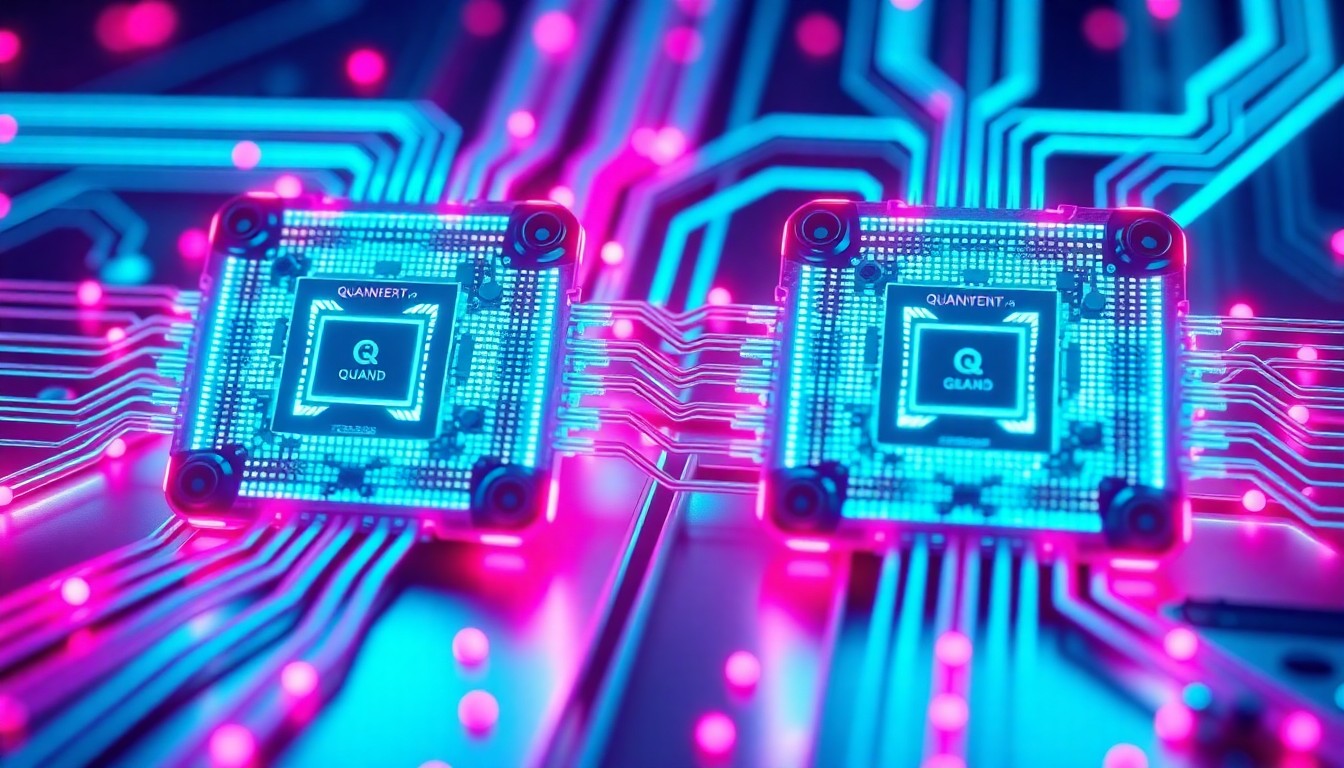 IonQ's breakthrough in photonic interconnection demonstrates the potential for scalable, networked quantum computing to solve complex problems.College Park Today
IonQ, a leading quantum computing company, has achieved a major technical milestone by photonically interconnecting two independent trapped-ion quantum systems. This marks the first demonstration of connected, commercial quantum computers, a critical step toward scaling quantum computation beyond a single processor. The successful demonstration of these network qubits underscores the repeatability and reliability of IonQ's hardware as the company transitions toward fault-tolerant, modular systems.
Why it matters
Scaling quantum computing beyond individual processors is essential for realizing a future quantum internet and solving complex problems. IonQ's achievement in photonically linking two remote quantum systems validates the theory and prior lab demonstrations of using photonic links to interconnect separated quantum platforms while preserving the coherence necessary for advanced quantum operations.
The details
By successfully linking two remote quantum systems, IonQ has validated the generation, transmission, and detection of photons used to enable quantum entanglement between two commercial IonQ computers at a distance for the first time. This demonstration proves that IonQ's trapped-ion platform is uniquely suited for the high-fidelity networking required to scale quantum computation.
- The successful demonstration was achieved in April 2026.
The players
IonQ
A leading quantum computing company that has achieved a major milestone in photonically interconnecting two independent quantum systems, a critical step toward scaling quantum computation.
Niccolo de Masi
The CEO of IonQ, who stated that achieving this photonic interconnect milestone is a pivotal moment in the company's roadmap as it moves from individual quantum processors to distributed, networked architectures.
Air Force Research Laboratory (AFRL)
The primary scientific research and development center for the Department of the Air Force, which partially funded the project with IonQ to advance national security and scientific research capabilities.
What they’re saying
“Achieving this photonic interconnect milestone is a pivotal moment in our roadmap as we move from individual quantum processors to distributed, networked architectures. Scaling quantum computation beyond the limits of a single chip is essential for realizing a future quantum internet. This demonstration proves that our trapped-ion platform is uniquely suited for the high-fidelity networking required to solve the world's most complex problems.”
— Niccolo de Masi, CEO, IonQ
What’s next
The successful demonstration of these network qubits underscores the repeatability and reliability of IonQ's hardware as the company transitions toward fault-tolerant, modular systems.
The takeaway
IonQ's achievement in photonically linking two remote quantum systems is a significant milestone in the development of scalable, networked quantum computing, which is essential for realizing the full potential of quantum technology to solve complex problems across various industries.