- Today
- Holidays
- Birthdays
- Reminders
- Cities
- Atlanta
- Austin
- Baltimore
- Berwyn
- Beverly Hills
- Birmingham
- Boston
- Brooklyn
- Buffalo
- Charlotte
- Chicago
- Cincinnati
- Cleveland
- Columbus
- Dallas
- Denver
- Detroit
- Fort Worth
- Houston
- Indianapolis
- Knoxville
- Las Vegas
- Los Angeles
- Louisville
- Madison
- Memphis
- Miami
- Milwaukee
- Minneapolis
- Nashville
- New Orleans
- New York
- Omaha
- Orlando
- Philadelphia
- Phoenix
- Pittsburgh
- Portland
- Raleigh
- Richmond
- Rutherford
- Sacramento
- Salt Lake City
- San Antonio
- San Diego
- San Francisco
- San Jose
- Seattle
- Tampa
- Tucson
- Washington
Cuba Today
By the People, for the People
US Intervention in Latin America: A Long, Deadly History
From the Monroe Doctrine to the Trump Corollary, the US has a long record of meddling in Latin America, often with devastating consequences.
Apr. 12, 2026 at 4:21pm
Got story updates? Submit your updates here. ›
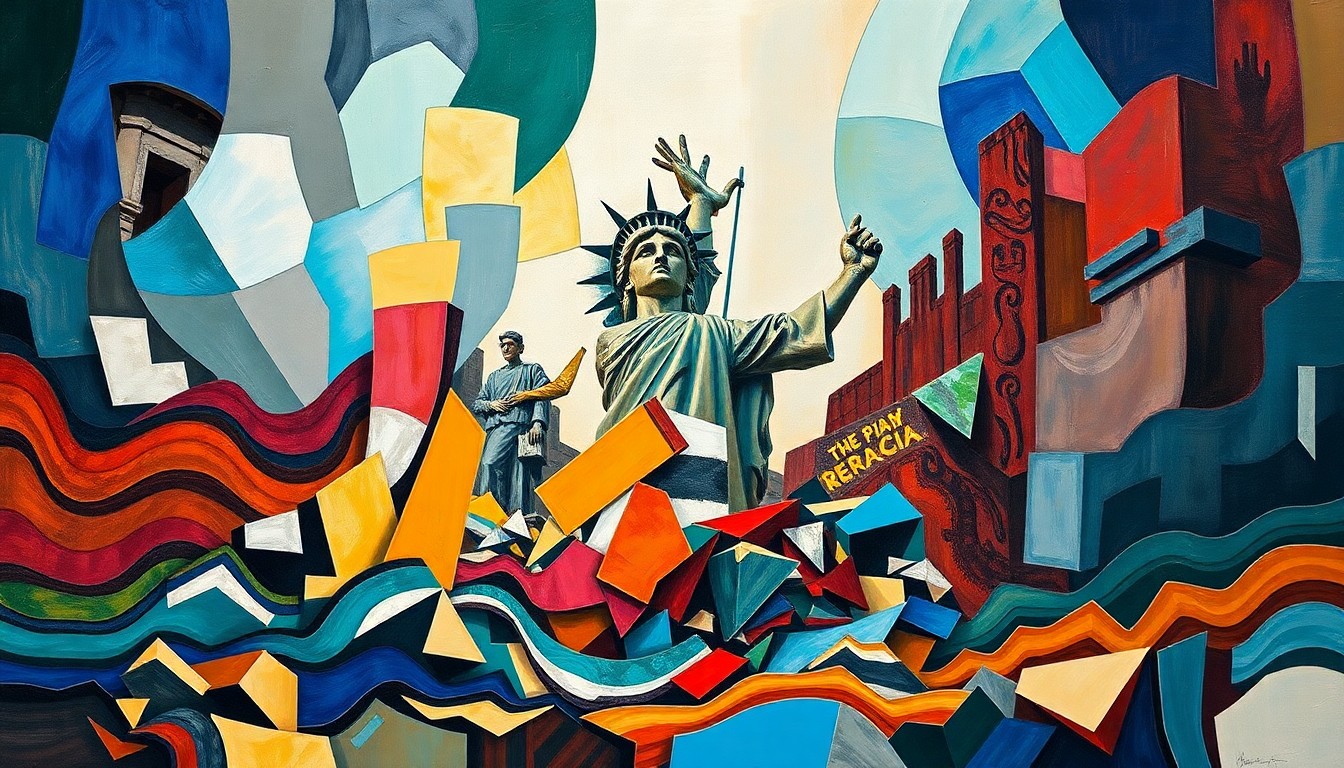 A fractured, abstract painting captures the turbulent history of US interference in Latin America, leaving a legacy of broken monuments and shattered dreams.Cuba Today
The United States has a long, troubled history of intervening in Latin American affairs, often in pursuit of economic and geopolitical interests. From the Monroe Doctrine to the recent 'Trump Corollary,' the US has justified military action, coups, and other forms of interference under the guise of combating communism, drug trafficking, and threats to US hegemony. This article examines key moments in this history, including the CIA-backed overthrow of Guatemala's Jacobo Arbenz, the Bay of Pigs invasion of Cuba, and the recent US-led kidnapping of Venezuelan President Nicolás Maduro.
Why it matters
The US's interventionist policies in Latin America have had profound and lasting impacts, contributing to political instability, human rights abuses, and economic hardship across the region. Understanding this history is crucial for contextualizing current US actions and their potential consequences, as well as for challenging the narratives used to justify continued interference.
The details
The US's long history of meddling in Latin America dates back to the 19th century and the Monroe Doctrine, which sought to limit European influence in the region. Over the decades, the US has invoked various corollaries and doctrines to justify military interventions, coups, and other forms of interference, often in pursuit of economic interests like controlling oil supplies. Recent examples include the CIA-backed overthrow of Guatemalan President Jacobo Arbenz in 1954, the failed Bay of Pigs invasion of Cuba in 1961, and the 2019 kidnapping of Venezuelan President Nicolás Maduro by US special forces.
- In 1972, the US expressed concerns about the possibility of Venezuela nationalizing its oil resources.
- In 1975, US Secretary of State Henry Kissinger sent a telegram threatening Venezuela over the nationalization of its oil industry.
- On January 1, 1976, Venezuelan President Carlos Andres Perez announced the nationalization of the country's oil industry.
- In 2017, US President Donald Trump invoked the Monroe Doctrine at the United Nations General Assembly, targeting Venezuela.
- In 2019, the Trump administration deployed the US navy to the region, citing alleged drug trafficking by the Maduro government.
The players
Donald Trump
The former president of the United States who dispatched special forces to kidnap Venezuelan President Nicolás Maduro and his wife, Cilia Flores, in 2026.
Nicolás Maduro
The president of Venezuela who was kidnapped by US special forces in 2026 on unfounded allegations of narcotrafficking.
Cilia Flores
The wife of Venezuelan President Nicolás Maduro, who was also kidnapped by US special forces in 2026.
Henry Kissinger
The US Secretary of State who sent a threatening telegram to Venezuela in 1975 over the nationalization of its oil industry.
Carlos Andres Perez
The president of Venezuela who announced the nationalization of the country's oil industry in 1976.
What they’re saying
“After years of neglect, the United States will reassert and enforce the Monroe doctrine to restore American preeminence in the Western Hemisphere, and to protect our homeland and our access to key geographies in the region.”
— Trump Administration, National Security Strategy Document
“This is the Western Hemisphere. This is where we live — and we're not going to allow the Western Hemisphere to be a base of operation for adversaries, competitors, and rivals of the United States.”
— Marco Rubio, US Secretary of State
“We are too rich and powerful to leave the nations of our hemisphere to drift alone into economic stagnation and social upheaval. That such a drift could open the hemisphere to hostile foreign powers is true; but more fundamentally, it would be incompatible with our own history and principles.”
— US Government, 1969 Memorandum
What’s next
The judge in the case against Maduro and Flores will decide on Tuesday whether to allow them out on bail.
The takeaway
The US's long history of meddling in Latin America, from the Monroe Doctrine to the Trump Corollary, has had devastating consequences for the region. This case highlights the need to challenge the narratives used to justify continued US interference and to hold the US accountable for its actions.