- Today
- Holidays
- Birthdays
- Reminders
- Cities
- Atlanta
- Austin
- Baltimore
- Berwyn
- Beverly Hills
- Birmingham
- Boston
- Brooklyn
- Buffalo
- Charlotte
- Chicago
- Cincinnati
- Cleveland
- Columbus
- Dallas
- Denver
- Detroit
- Fort Worth
- Houston
- Indianapolis
- Knoxville
- Las Vegas
- Los Angeles
- Louisville
- Madison
- Memphis
- Miami
- Milwaukee
- Minneapolis
- Nashville
- New Orleans
- New York
- Omaha
- Orlando
- Philadelphia
- Phoenix
- Pittsburgh
- Portland
- Raleigh
- Richmond
- Rutherford
- Sacramento
- Salt Lake City
- San Antonio
- San Diego
- San Francisco
- San Jose
- Seattle
- Tampa
- Tucson
- Washington
Notre Dame Coach Reveals NIL Impact on Playing Time
Marcus Freeman discusses how name, image and likeness deals factor into roster decisions.
Apr. 16, 2026 at 12:10am
Got story updates? Submit your updates here. ›
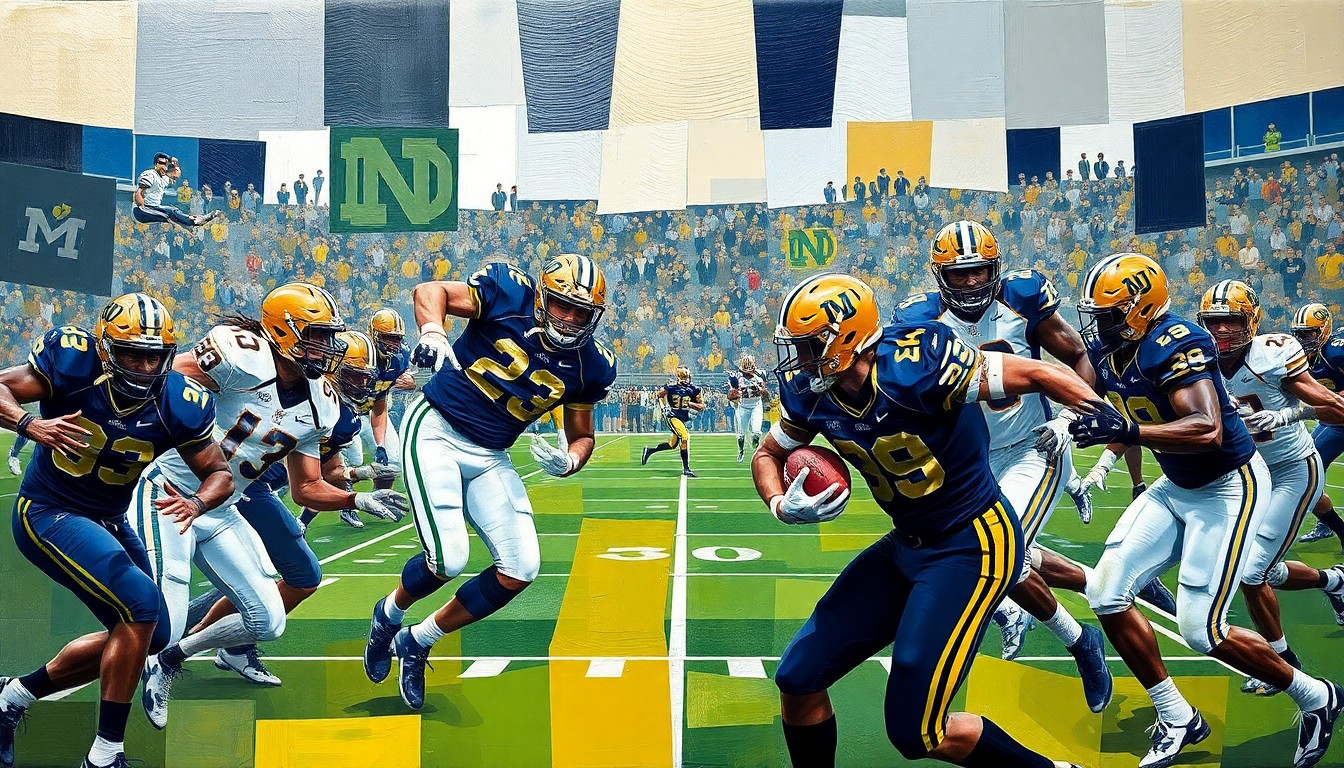 A cubist interpretation of a college football game captures the strategic complexity and competing forces at play in the NIL era.Notre Dame Today
In an interview, Notre Dame head football coach Marcus Freeman discussed how the rise of name, image and likeness (NIL) deals in college sports has impacted his approach to playing time decisions. Freeman said that while NIL payouts could theoretically lead to favoring higher-paid players, his philosophy is that incoming freshmen must earn their spots through on-field performance, regardless of their NIL compensation.
Why it matters
The NIL era has fundamentally changed the landscape of college athletics, with players now able to earn significant sums of money through endorsement deals. Freeman's comments provide insight into how some coaches are navigating this new reality and trying to maintain a meritocratic approach to roster management.
The details
Freeman cited two instances during his time at Notre Dame where the school brought in high-profile transfer quarterbacks in Sam Hartman and Riley Leonard. He said that if the quarterback competition had ended in a tie, he would have been inclined to give the starting job to the higher-paid player to make it 'fair' for that player. However, Freeman said this has not been a common issue, as his general philosophy is that incoming freshmen must earn their playing time through hard work and performance, regardless of their NIL earnings. He believes this approach is better suited to the current NIL landscape, where younger players can also capitalize on their name, image and likeness if they prove themselves on the field.
- In 2023, Notre Dame brought in quarterback Sam Hartman as a transfer.
- In 2024, Notre Dame brought in quarterback Riley Leonard as a transfer.
The players
Marcus Freeman
The head football coach at the University of Notre Dame.
Sam Hartman
A quarterback who transferred to Notre Dame in 2023.
Riley Leonard
A quarterback who transferred to Notre Dame in 2024.
What they’re saying
“If it's a tie, you have to put the guy out there you've invested the most money in because it's not fair to the guy who's starting. Because the minute he throws an incomplete pass, they're going to boo him and say get the other guy in.”
— Marcus Freeman, Head Coach
“Your incoming freshmen aren't making the money that your dudes are making. So they have to earn the right to make more money. When they earn the right, they've earned it on the field, and then they're compensated for it.”
— Marcus Freeman, Head Coach
What’s next
As the NIL era continues to evolve, coaches like Marcus Freeman will likely continue to navigate the balance between compensating top players and maintaining a meritocratic approach to playing time decisions.
The takeaway
Freeman's comments highlight the nuanced challenges coaches face in the NIL era, where they must balance fairness to highly compensated players with rewarding on-field performance, especially from younger players. His philosophy of freshmen earning their spots through hard work aligns with the spirit of the NIL rules, which aim to empower athletes to profit from their name, image and likeness.