- Today
- Holidays
- Birthdays
- Reminders
- Cities
- Atlanta
- Austin
- Baltimore
- Berwyn
- Beverly Hills
- Birmingham
- Boston
- Brooklyn
- Buffalo
- Charlotte
- Chicago
- Cincinnati
- Cleveland
- Columbus
- Dallas
- Denver
- Detroit
- Fort Worth
- Houston
- Indianapolis
- Knoxville
- Las Vegas
- Los Angeles
- Louisville
- Madison
- Memphis
- Miami
- Milwaukee
- Minneapolis
- Nashville
- New Orleans
- New York
- Omaha
- Orlando
- Philadelphia
- Phoenix
- Pittsburgh
- Portland
- Raleigh
- Richmond
- Rutherford
- Sacramento
- Salt Lake City
- San Antonio
- San Diego
- San Francisco
- San Jose
- Seattle
- Tampa
- Tucson
- Washington
Mazon Today
By the People, for the People
Researchers Reclassify World's Oldest 'Octopus' Fossil as Ancient Nautilus
The 300-million-year-old Pohlsepia mazonensis fossil found in Illinois has been determined to be a relative of the modern nautilus, not the oldest known octopus.
Apr. 13, 2026 at 5:50pm
Got story updates? Submit your updates here. ›
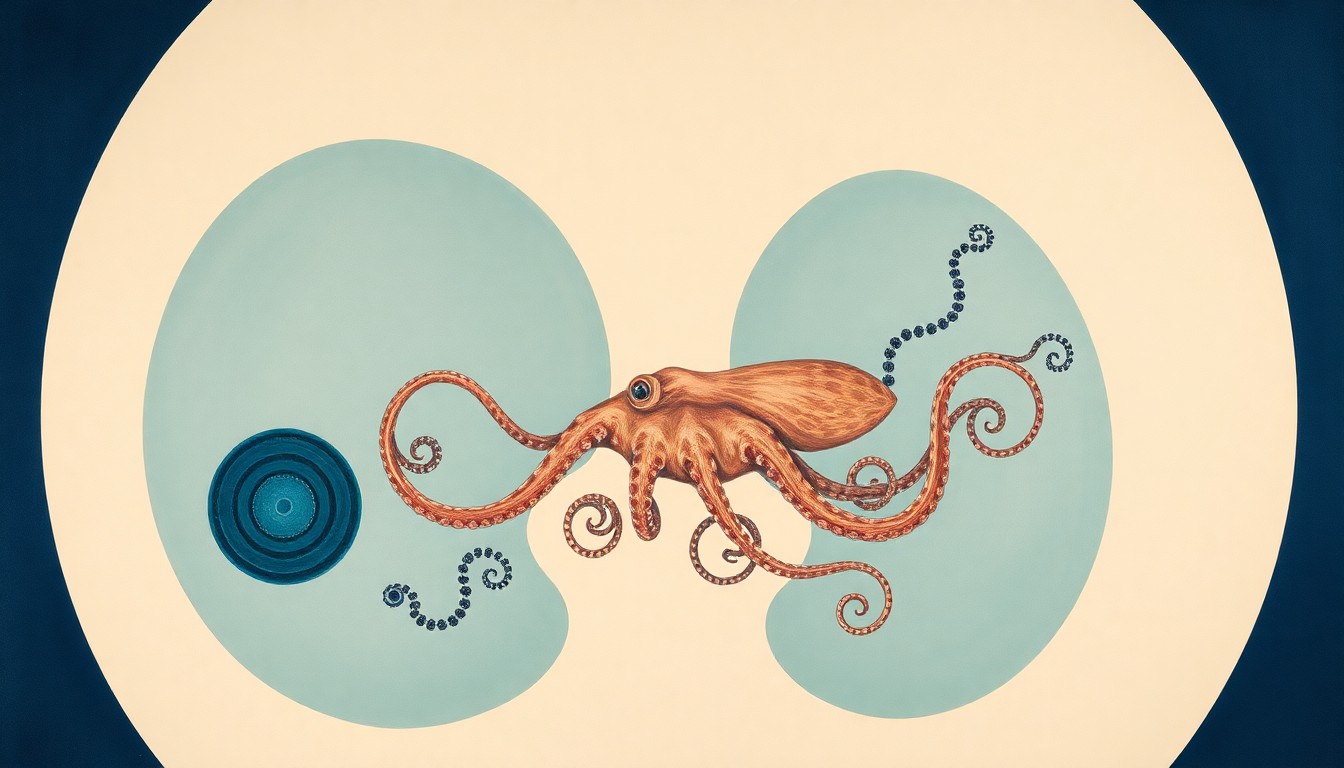
 A conceptual illustration depicting the evolutionary relationship between ancient nautilus-like cephalopods and modern octopuses, as revealed by the reclassification of the world's oldest 'octopus' fossil.Mazon Today
A recent study published in the journal Proceedings of the Royal Society B has found that the 300-million-year-old fossil Pohlsepia mazonensis, previously identified as the world's oldest octopus, is actually a relative of the modern nautilus. Researchers examined the fossil's teeth using a synchrotron and determined it had too many teeth to be an octopus, leading them to reclassify it as an ancient nautiloid.
Why it matters
The reclassification of this fossil has significant implications for our understanding of the evolutionary history of cephalopods. It closes a 210-million-year gap in the octopus fossil record, raising new questions about the origins and early evolution of this marine animal group.
The details
The Pohlsepia mazonensis fossil was first identified as the world's oldest octopus in 2000, but researchers have long questioned this classification. The recent study led by University of Reading zoologist Thomas Clements found that the fossil's teeth, which were examined using a synchrotron, had 11 teeth per row, more than the 7 or 9 typically found in octopuses. This led the researchers to determine the fossil was actually a relative of the modern nautilus, a shell-covered cephalopod.
- The Pohlsepia mazonensis fossil was discovered in the Mazon Creek fossil beds of northeastern Illinois.
- The fossil was first identified as the world's oldest octopus in 2000.
- The recent study reclassifying the fossil as an ancient nautilus was published in the journal Proceedings of the Royal Society B in 2026.
The players
Thomas Clements
The lead researcher of the study that reclassified the Pohlsepia mazonensis fossil as an ancient nautilus relative, Clements is a zoologist at the University of Reading.
Paul Mayer
The manager of the fossil invertebrate collections at the Field Museum in Chicago, where the Pohlsepia mazonensis fossil is currently held.
What they’re saying
“To look at it, it kind of just looks like a white mush. If you look at it, and you are a cephalopod researcher, and you're interested in everything octopus, it does superficially look a lot like a deep-water octopus.”
— Thomas Clements, Lead Researcher
“This has too many teeth, so it can't be an octopus. And that's how we realized that the world's oldest octopus is actually a fossil nautilus, not an octopus.”
— Thomas Clements, Lead Researcher
“People have been questioning whether it was an octopus ever since the original paper was first published in 2000.”
— Paul Mayer, Fossil Collections Manager
What’s next
Researchers plan to continue studying the Pohlsepia mazonensis fossil and other ancient cephalopod specimens to further understand the evolutionary history of these marine animals.
The takeaway
The reclassification of the Pohlsepia mazonensis fossil as an ancient nautilus relative rather than the world's oldest octopus highlights the importance of ongoing scientific research and reexamination of long-held assumptions. This discovery will help fill a significant gap in the octopus fossil record and spur new investigations into cephalopod evolution.