- Today
- Holidays
- Birthdays
- Reminders
- Cities
- Atlanta
- Austin
- Baltimore
- Berwyn
- Beverly Hills
- Birmingham
- Boston
- Brooklyn
- Buffalo
- Charlotte
- Chicago
- Cincinnati
- Cleveland
- Columbus
- Dallas
- Denver
- Detroit
- Fort Worth
- Houston
- Indianapolis
- Knoxville
- Las Vegas
- Los Angeles
- Louisville
- Madison
- Memphis
- Miami
- Milwaukee
- Minneapolis
- Nashville
- New Orleans
- New York
- Omaha
- Orlando
- Philadelphia
- Phoenix
- Pittsburgh
- Portland
- Raleigh
- Richmond
- Rutherford
- Sacramento
- Salt Lake City
- San Antonio
- San Diego
- San Francisco
- San Jose
- Seattle
- Tampa
- Tucson
- Washington
Inhibitory Neurons Found to Drive Movement in Fruit Flies
UCSB researchers uncover new insights into the neural circuitry behind complex behaviors like grooming.
Apr. 15, 2026 at 4:26am
Got story updates? Submit your updates here. ›
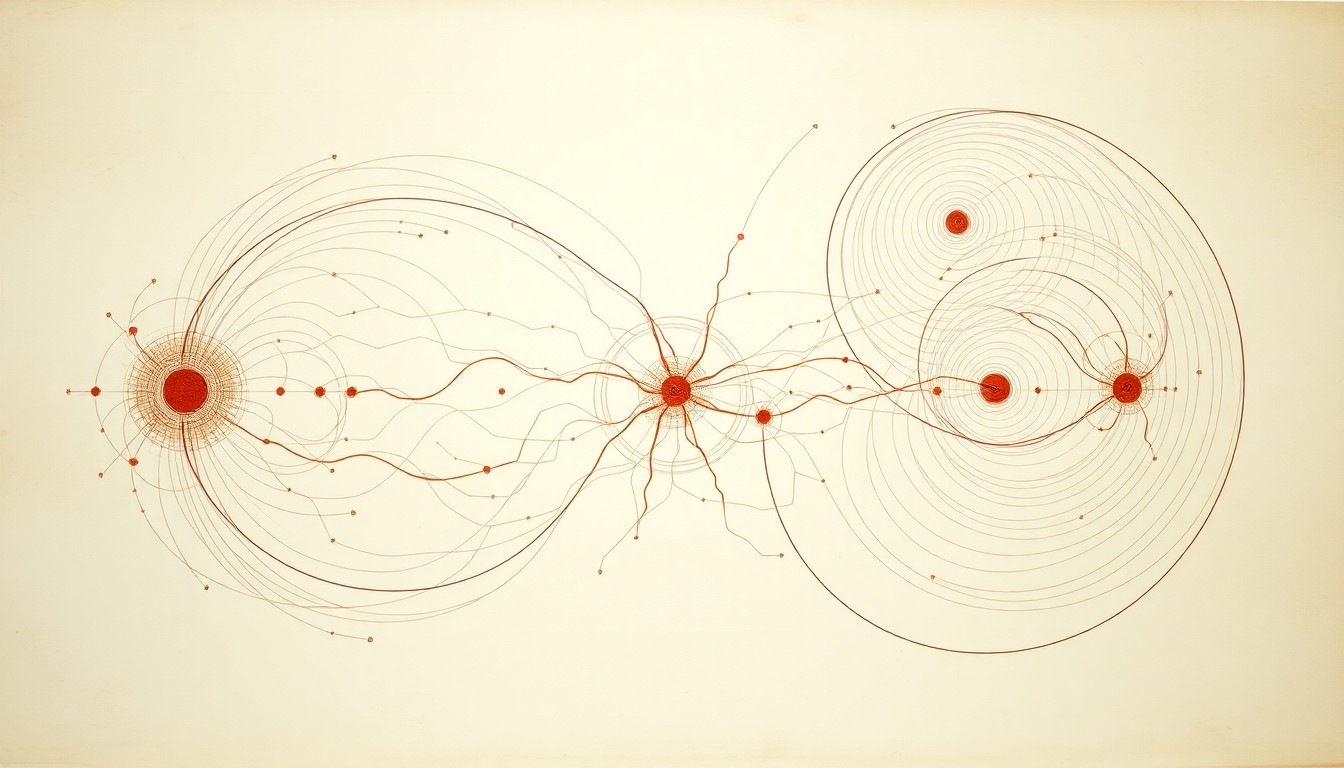 An abstract neural diagram illustrates the intricate inhibitory circuits that coordinate complex behaviors like grooming in fruit flies.Santa Barbara Today
Researchers at UC Santa Barbara have found that inhibitory neurons - previously thought to suppress movement - actually play a key role in generating and coordinating the rhythmic limb movements required for grooming in fruit flies. This discovery challenges traditional assumptions about the neural mechanisms underlying behavior and has potential implications for robotics and biomimetic design.
Why it matters
This research sheds new light on the complexities of the animal nervous system and how sensory inputs are translated into coordinated physical actions. Understanding these neural circuits could inform the development of more sophisticated robotic and biomimetic systems that can mimic natural behaviors.
The details
The researchers used optogenetic experiments to reveal that inhibitory pre-motor neurons, which function as a 'stop' signal, are capable of driving movement without the need for excitatory signals. These neurons coordinate the alternation between muscle extension and flexion, allowing for repetitive grooming motions. The team also found that the fly nervous system utilizes both 'specialist' inhibitory neurons that control individual joints and 'generalist' neurons that can switch between common motion patterns like grooming, flying, and walking.
- This work began before the full fruit fly connectome was completed in late 2024.
- The research is the result of years of effort by the UCSB researchers and undergraduate students who helped trace the paths of individual inhibitory neurons.
The players
Durafshan Sakeena Syed
A postdoctoral researcher in the Simpson Lab at UC Santa Barbara who led this study.
Primoz Ravbar
A researcher in the Simpson Lab who collaborated on building computational models to test the neural circuits.
Julie H. Simpson
A neuroscientist at UC Santa Barbara who oversees the Simpson Lab where this research was conducted.
UCSB Undergraduates
Cohorts of students who helped proofread electron microscopy data and trace the paths of inhibitory neurons, making important contributions to the foundations of this discovery.
What they’re saying
“We are at a very exciting time right now.”
— Durafshan Sakeena Syed, Postdoctoral Researcher
“The thing is, when you think about movement, traditionally you assume that the activated pre-motor neuron would excite the motor neuron. Instead, our optogenetic experiments revealed that these inhibitory pre-motor neurons, which function as a 'stop' signal, are capable of driving movement without the need for excitatory signals.”
— Durafshan Sakeena Syed, Postdoctoral Researcher
What’s next
Future work may involve further investigations into how the fly nervous system enables transitions between complex behaviors, which could inform studies of more advanced organisms.
The takeaway
This research challenges traditional assumptions about the role of inhibitory neurons, revealing their active involvement in generating and coordinating rhythmic movements. These findings have potential implications for the development of more sophisticated robotic and biomimetic systems that can mimic natural behaviors.