- Today
- Holidays
- Birthdays
- Reminders
- Cities
- Atlanta
- Austin
- Baltimore
- Berwyn
- Beverly Hills
- Birmingham
- Boston
- Brooklyn
- Buffalo
- Charlotte
- Chicago
- Cincinnati
- Cleveland
- Columbus
- Dallas
- Denver
- Detroit
- Fort Worth
- Houston
- Indianapolis
- Knoxville
- Las Vegas
- Los Angeles
- Louisville
- Madison
- Memphis
- Miami
- Milwaukee
- Minneapolis
- Nashville
- New Orleans
- New York
- Omaha
- Orlando
- Philadelphia
- Phoenix
- Pittsburgh
- Portland
- Raleigh
- Richmond
- Rutherford
- Sacramento
- Salt Lake City
- San Antonio
- San Diego
- San Francisco
- San Jose
- Seattle
- Tampa
- Tucson
- Washington
Dark Matter May Unlock Early Supermassive Black Holes
UCR study shows decaying dark matter could seed direct collapse black holes in early universe
Apr. 16, 2026 at 5:56am
Got story updates? Submit your updates here. ›
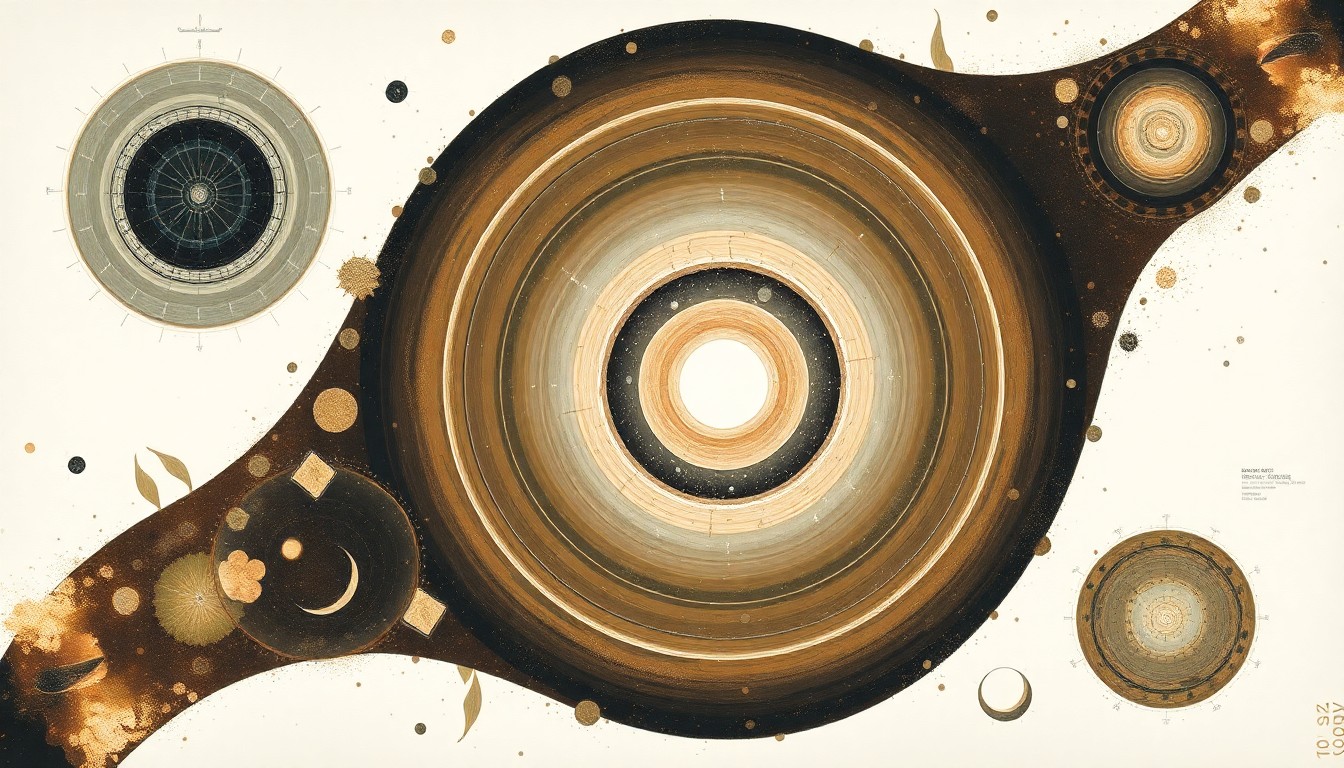 An abstract visualization of how decaying dark matter could have profoundly reshaped the early universe, seeding the formation of supermassive black holes.Riverside Today
A new study led by UC Riverside graduate student Yash Aggarwal suggests that decaying dark matter could be the key to understanding the origin of supermassive black holes that existed less than a billion years after the Big Bang. The research shows that the energy released from dark matter decay could alter the chemistry of early galaxies enough to cause some of them to directly collapse into black holes rather than forming stars.
Why it matters
The presence of these gargantuan black holes in the early universe has been a growing mystery in astronomy, as the standard theory of black hole formation suggests they should not have had enough time to grow so large. This new mechanism proposed by the UCR team could help explain the formation of these unusually large black holes that NASA's James Webb Space Telescope continues to observe.
The details
Aggarwal's team used dark matter - the unknown 85% of the matter in the universe that helps form galaxies - to model the thermo-chemical dynamics of the gas in the presence of decaying axions. They found that a window of dark matter masses between 24 and 27 electronvolts could produce the conditions to seed direct collapse black holes, rather than the standard process of stars forming first and then collapsing into black holes.
- The research was published in the Journal of Cosmology and Astroparticle Physics in 2026.
- NASA's James Webb Space Telescope continues to observe unusually large black holes in the early universe.
The players
Yash Aggarwal
A UC Riverside graduate student and lead author of the study.
Flip Tanedo
An associate professor of physics and astronomy at UCR and Aggarwal's doctoral co-advisor.
James Dent
A researcher from Sam Houston State University in Texas and co-author on the paper.
Tao Xu
A researcher from the University of Oklahoma and co-author on the paper.
University of California, Riverside
The university where the research was conducted.
What they’re saying
“Our study suggests that decaying dark matter could profoundly reshape the evolution of the first stars and galaxies, with widespread effects across the universe.”
— Yash Aggarwal, UC Riverside graduate student
“The first galaxies are essentially balls of pristine hydrogen gas whose chemistry is incredibly sensitive to atomic-scale energy injection. These are the properties that we want for a dark matter detector — the signature of these 'detectors' might be the supermassive black holes that we see today.”
— Flip Tanedo, Associate professor of physics and astronomy at UCR
What’s next
The research team plans to continue studying the effects of decaying dark matter on the formation of early galaxies and supermassive black holes, with the goal of providing more insights that can be tested by future observations from telescopes like the James Webb Space Telescope.
The takeaway
This study offers a novel explanation for the presence of supermassive black holes in the early universe, suggesting that decaying dark matter could have profoundly shaped the evolution of the first stars and galaxies. As astronomers continue to uncover more of these cosmic behemoths, this mechanism may help bridge the gap between theory and observation.
Riverside top stories



Riverside events

Apr. 18, 2026
Fant-A-Shes
Apr. 18, 2026
Ultra Sunn