- Today
- Holidays
- Birthdays
- Reminders
- Cities
- Atlanta
- Austin
- Baltimore
- Berwyn
- Beverly Hills
- Birmingham
- Boston
- Brooklyn
- Buffalo
- Charlotte
- Chicago
- Cincinnati
- Cleveland
- Columbus
- Dallas
- Denver
- Detroit
- Fort Worth
- Houston
- Indianapolis
- Knoxville
- Las Vegas
- Los Angeles
- Louisville
- Madison
- Memphis
- Miami
- Milwaukee
- Minneapolis
- Nashville
- New Orleans
- New York
- Omaha
- Orlando
- Philadelphia
- Phoenix
- Pittsburgh
- Portland
- Raleigh
- Richmond
- Rutherford
- Sacramento
- Salt Lake City
- San Antonio
- San Diego
- San Francisco
- San Jose
- Seattle
- Tampa
- Tucson
- Washington
Alameda Today
By the People, for the People
Penumbra's Computer-Assisted Thrombectomy Outperforms Anticoagulation Alone
Landmark STORM-PE trial shows significant functional improvements for patients with acute intermediate-high risk pulmonary embolism.
Apr. 13, 2026 at 7:06pm
Got story updates? Submit your updates here. ›
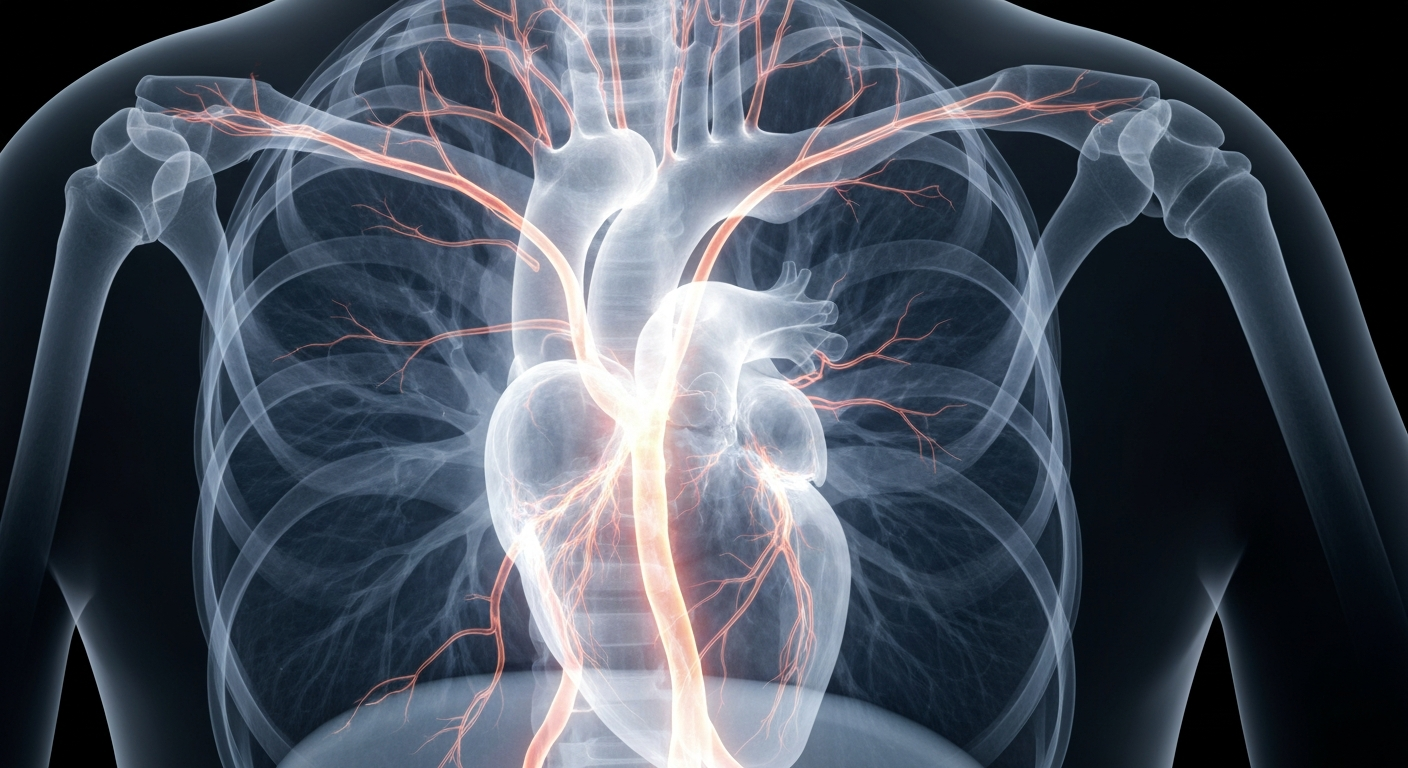 An advanced medical imaging technique reveals the intricate vascular structures affected by pulmonary embolism, informing new treatment approaches.Alameda Today
Penumbra, a medical device company, has announced positive 90-day results from its landmark STORM-PE randomized trial evaluating its computer-assisted vacuum thrombectomy (CAVT) technology for treating acute intermediate-high risk pulmonary embolism. The study found that CAVT plus anticoagulation achieved greater functional improvements compared to anticoagulation alone, including patients walking significantly further and experiencing no physical limitations.
Why it matters
The STORM-PE trial provides important clinical evidence supporting the use of endovascular therapy, including Penumbra's CAVT technology, as a treatment option beyond just anticoagulation for patients with acute intermediate-high risk pulmonary embolism. Improved functional outcomes and quality of life are crucial considerations for patients dealing with this serious cardiovascular condition.
The details
The STORM-PE trial evaluated 479 patients with acute intermediate-high risk pulmonary embolism. Patients treated with CAVT plus anticoagulation walked an average of 479 meters in a six-minute walk test, compared to 368 meters for the anticoagulation-only group. CAVT recipients also returned to their pre-PE functional status, while the anticoagulation-only group did not. Safety rates were comparable across both arms, with no device-related mortality or increased PE-related mortality.
- Penumbra presented the STORM-PE findings at the Society of Interventional Radiology (SIR) Annual Scientific Meeting in Toronto.
- The STORM-PE results build on outcomes previously shared at the Vascular Interventional Advances (VIVA) 2025 Conference in November and TCT 2025 Conference.
The players
Penumbra
An Alameda, California-based medical device company that developed the Lightning Flash thrombectomy system used in the STORM-PE trial.
Dr. Robert Lookstein
Co-global principal investigator of the STORM-PE RCT and professor of radiology and surgery at Icahn School of Medicine at Mount Sinai.
Dr. Rachel Rosovsky
Co-global principal investigator of the STORM-PE randomized controlled trial, hematologist at Massachusetts General Hospital, and associate professor of medicine at Harvard Medical School.
Dr. James F. Benenati
Penumbra's chief medical officer.
What they’re saying
“Together with the initial STORM‑PE results, which demonstrated faster reperfusion and improved right ventricular recovery, this 90 day data highlights significant patient‑centered benefits of CAVT in intermediate‑high risk PE. This pivotal trial continues to build important clinical evidence supporting the role of endovascular therapy beyond anticoagulation alone and helps inform how treatment strategies including CAVT for PE may continue to evolve in future clinical guidelines.”
— Dr. Robert Lookstein, Co-global principal investigator of the STORM-PE RCT and professor of radiology and surgery at Icahn School of Medicine at Mount Sinai
“STORM-PE continues to highlight emerging benefits of treatment beyond anticoagulation alone for patients with intermediate‑high risk PE. These functional endpoints are important because they reflect outcomes that matter to patients and directly affect their daily lives. Collectively, the STORM‑PE data suggest that PE care is evolving, and that the thoughtful adoption of endovascular treatment options has the potential to greatly improve patient outcomes and recovery.”
— Dr. Rachel Rosovsky, Co‑global principal investigator of the STORM‑PE randomized controlled trial, hematologist at Massachusetts General Hospital, and associate professor of medicine at Harvard Medical School
“Historically, there has been limited randomized evidence describing how different treatment strategies for PE influence longer‑term recovery. In STORM‑PE, those treated with CAVT achieved significantly greater gains in objective functional measures, including 6‑minute walk distance, compared to anticoagulation alone. Data from STRIKE-PE support a similar recovery trajectory in a broader patient population. Together, these findings provide robust evidence supporting a greater role for CAVT in the treatment of acute intermediate‑high risk PE and reinforce its impact on physiological and functional outcomes.”
— Dr. James F. Benenati, Penumbra chief medical officer
What’s next
Penumbra plans to continue evaluating the long-term quality of life and functional outcomes of its CAVT technology through the ongoing STRIKE-PE real-world study, which aims to enroll up to 1,500 patients.
The takeaway
The STORM-PE trial results demonstrate that Penumbra's computer-assisted vacuum thrombectomy (CAVT) technology can significantly improve functional outcomes and quality of life for patients with acute intermediate-high risk pulmonary embolism, beyond what is achievable with anticoagulation alone. This provides strong clinical evidence supporting the expanded use of endovascular therapies like CAVT in the treatment of this serious cardiovascular condition.