- Today
- Holidays
- Birthdays
- Reminders
- Cities
- Atlanta
- Austin
- Baltimore
- Berwyn
- Beverly Hills
- Birmingham
- Boston
- Brooklyn
- Buffalo
- Charlotte
- Chicago
- Cincinnati
- Cleveland
- Columbus
- Dallas
- Denver
- Detroit
- Fort Worth
- Houston
- Indianapolis
- Knoxville
- Las Vegas
- Los Angeles
- Louisville
- Madison
- Memphis
- Miami
- Milwaukee
- Minneapolis
- Nashville
- New Orleans
- New York
- Omaha
- Orlando
- Philadelphia
- Phoenix
- Pittsburgh
- Portland
- Raleigh
- Richmond
- Rutherford
- Sacramento
- Salt Lake City
- San Antonio
- San Diego
- San Francisco
- San Jose
- Seattle
- Tampa
- Tucson
- Washington
Kingman Today
By the People, for the People
Route 66 Celebrates 100 Years as Quirky Tourist Destination
The former highway transforms into an 'economy of quirk' drawing visitors to roadside oddities and heritage sites.
Apr. 4, 2026 at 12:29pm
Got story updates? Submit your updates here. ›
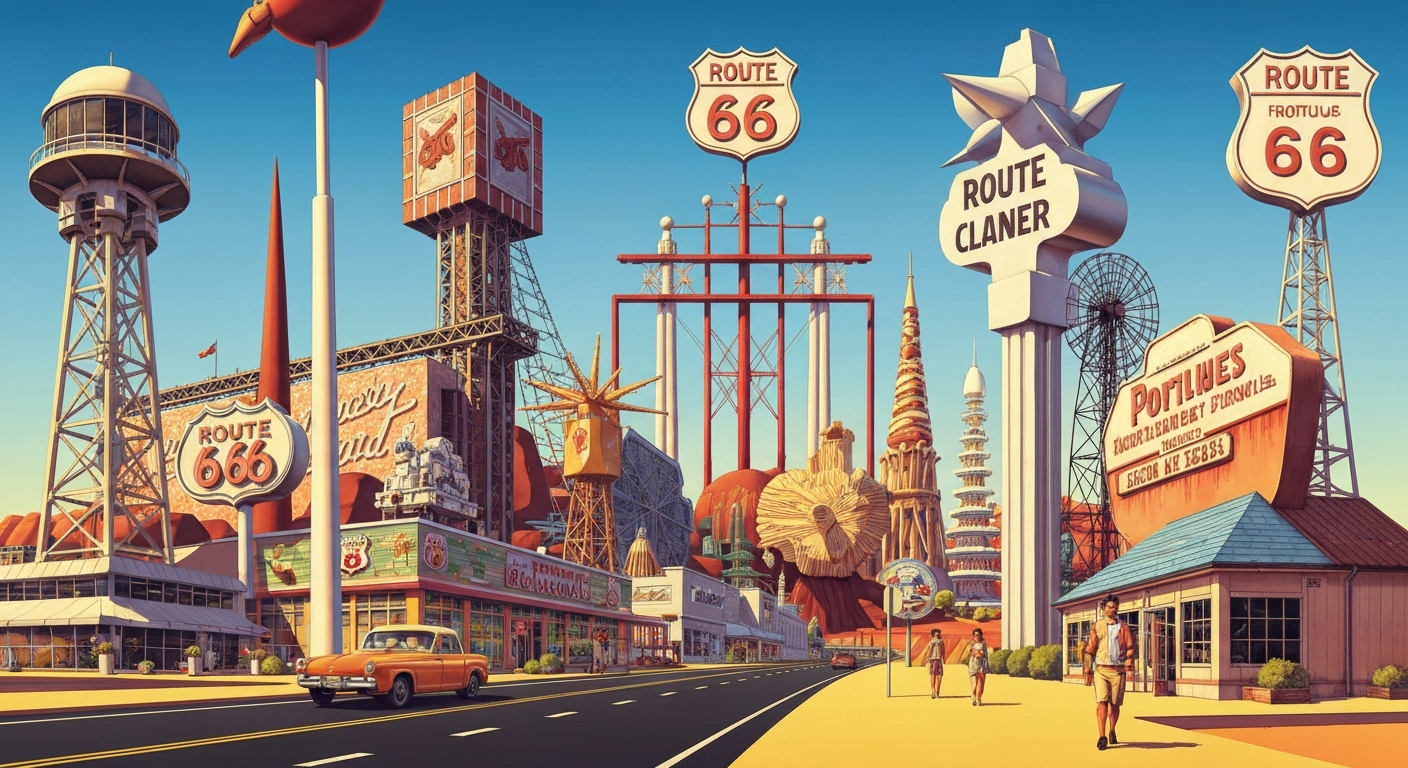 As Route 66 celebrates its 100th anniversary, the former highway has transformed into a high-value corridor of quirky, heritage-driven tourism experiences.Kingman Today
As Route 66 celebrates its 100th anniversary in 2026, the former highway has transitioned from a functional transportation artery to a high-value corridor of experiential tourism. Towns along the route have strategically pivoted toward nostalgia, roadside attractions, and heritage branding to draw international crowds to their 'economy of quirk' - a blend of vintage memorabilia, oversized spectacles, and ghost town experiences.
Why it matters
The decommissioning of Route 66 as an official U.S. highway in 1985 unexpectedly revived public interest, shifting the road's value proposition from transportation efficiency to cultural preservation and heritage tourism. This transformation has allowed small towns to adaptively reuse infrastructure and monetize the 'quirky' elements of the Mother Road, creating a decentralized, heritage-based economic model that will shape the long-term sustainability of these communities.
The details
From the Route 66 Association of Illinois Hall of Fame & Museum in Pontiac to the Massive Texan Steak Ranch & Brewery in Amarillo and the wild burros of Oatman, Arizona, towns along the route have strategically curated a 'economy of quirk' to draw visitors. This includes leveraging high-visibility 'photo ops', themed experiences like shootouts and bandit train rides, and viral marketing stunts like the 72-ounce steak challenge. The adaptive reuse of infrastructure, such as converting a former high school into the Pink Elephant Antique Mall, also demonstrates how these communities are balancing authentic preservation with the 'ridiculous' and 'wacky' elements that modern experiential travelers demand.
- Route 66 was decommissioned as an official U.S. highway in 1985.
- The Route 66 Association of Illinois Hall of Fame & Museum opened in Pontiac in 2004.
- The 72-ounce steak challenge at the Massive Texan Steak Ranch & Brewery in Amarillo has been running since the 1960s.
The players
Route 66 Association of Illinois
A non-profit organization that operates the Route 66 Hall of Fame & Museum in Pontiac, Illinois, which serves as a repository for thousands of pieces of Route 66 memorabilia.
Bob Waldmire
An artist known for his 'road yacht' - a converted double-decker school bus - which is featured at the Route 66 Hall of Fame & Museum and positions him as a precursor to the modern 'van life' movement.
Massive Texan Steak Ranch & Brewery
A restaurant in Amarillo, Texas that operates less like a traditional eatery and more like a themed destination, anchored by its 72-ounce steak challenge that has become a viral marketing engine.
Cadillac Ranch
An art installation near Amarillo, Texas featuring vintage Cadillacs buried in the dirt, which invites active consumer participation through spray painting.
Wild burros
Descendants of Gold Rush-era pack animals that now outnumber human residents in the ghost town of Oatman, Arizona, serving as a unique wildlife draw for visitors.
What’s next
As Route 66 celebrates its centennial, it remains to be seen whether the Mother Road will continue to rely on 20th-century nostalgia or evolve into a new form of sustainable regional tourism.
The takeaway
The transformation of Route 66 from a functional highway to a 'economy of quirk' highlights the adaptability of small towns and their ability to leverage heritage, roadside attractions, and experiential tourism to revitalize their local economies. This model may serve as a blueprint for other decommissioned transportation corridors seeking to reinvent themselves for the modern traveler.