- Today
- Holidays
- Birthdays
- Reminders
- Cities
- Atlanta
- Austin
- Baltimore
- Berwyn
- Beverly Hills
- Birmingham
- Boston
- Brooklyn
- Buffalo
- Charlotte
- Chicago
- Cincinnati
- Cleveland
- Columbus
- Dallas
- Denver
- Detroit
- Fort Worth
- Houston
- Indianapolis
- Knoxville
- Las Vegas
- Los Angeles
- Louisville
- Madison
- Memphis
- Miami
- Milwaukee
- Minneapolis
- Nashville
- New Orleans
- New York
- Omaha
- Orlando
- Philadelphia
- Phoenix
- Pittsburgh
- Portland
- Raleigh
- Richmond
- Rutherford
- Sacramento
- Salt Lake City
- San Antonio
- San Diego
- San Francisco
- San Jose
- Seattle
- Tampa
- Tucson
- Washington
Mutant Clownfish Reveals Secrets of Nature's Patterns
Researchers uncover the genetic mechanism behind a unique fish's corrugated stripes.
Apr. 4, 2026 at 5:06am
Got story updates? Submit your updates here. ›
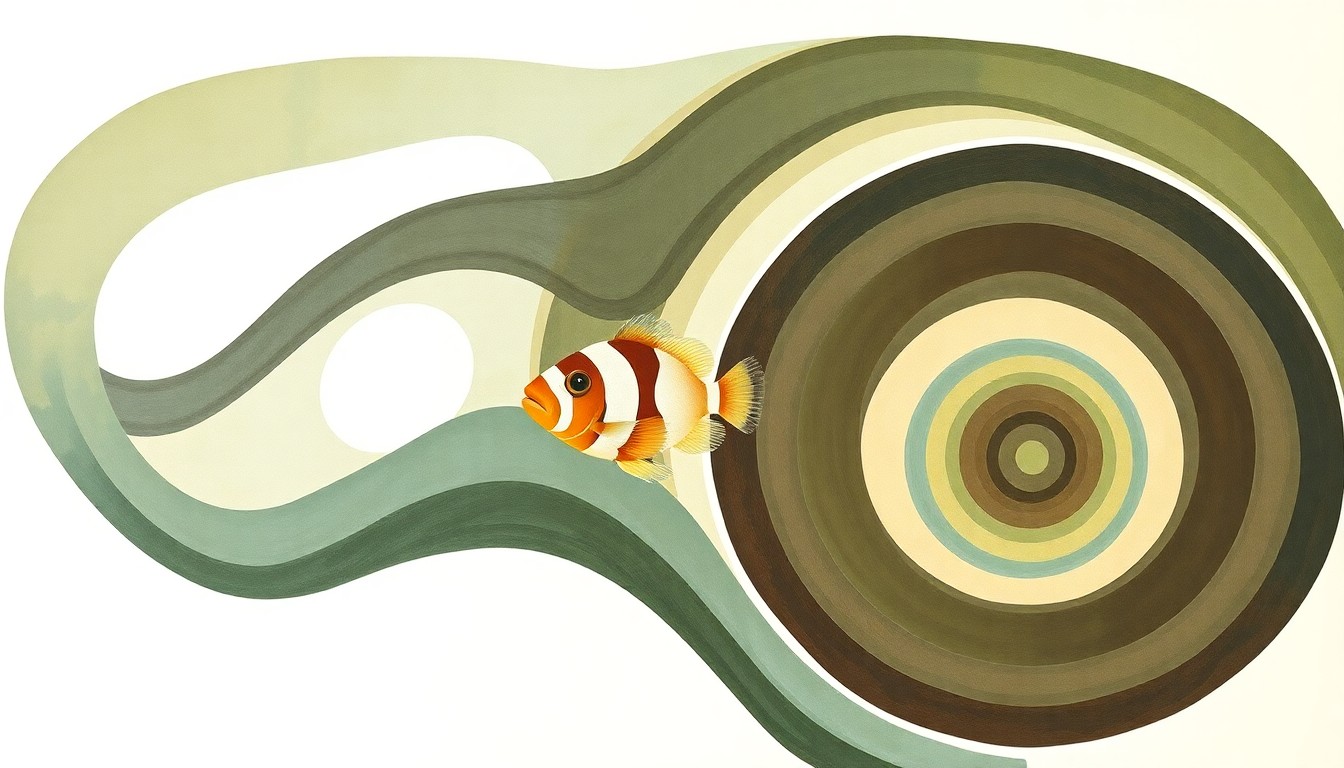 An abstract visualization of the genetic and physical forces that shape the unique corrugated stripes of the Snowflake clownfish, shedding light on the universal principles of pattern formation in nature.University of Virginia Today
In 1999, a clownfish with wavy, corrugated patterns instead of the usual straight bars was born in a UK aquarium. Two decades later, an international team of researchers has finally identified the exact gene responsible for this unique pigmentation, shedding light on the universal mechanisms behind how nature creates regular patterns across species.
Why it matters
The discovery of the genetic basis for the Snowflake clownfish's irregular stripes provides clues to the overarching mystery of how cells organize themselves into the consistent, symmetrical patterns seen in nature, from animal coats to plant leaves.
The details
Researchers from OIST, Academia Sinica, Kyoto University, and the University of Virginia found that the Snowflake clownfish's mutation occurred in the same gap junction gene that controls stripe formation in zebrafish. However, this gene appears to play a more general role in facilitating cell-to-cell communication, rather than just directing Turing pattern growth. The team also determined that a simple model of membrane physics, the Edwards-Wilkinson model, best explains how the clownfish's corrugated patterns form and disrupt the clean borders between pigmentation cells.
- In 1999, the mutant Snowflake clownfish first hatched in a UK aquarium.
- The new study was published in Nature Communications in 2026.
The players
Vincent Laudet
Professor at the Marine Eco-Evo-Devo Unit at the Okinawa Institute of Science and Technology (OIST).
Marleen Klann
First author of the study and researcher at the Marine Eco-Evo-Devo Unit at OIST.
Simone Pigolotti
Co-author of the study and Professor at the Biocomplexity Unit at OIST.
Masato Kinoshita
Professor at Kyoto University who helped engineer transgenic anemonefish for the study.
What they’re saying
“Conceptually, it should be simple. But in practice, it's mysterious. How does a cell know whether to be black, white, or orange, in a way that consistently creates clearly organized patterns at a macroscale? Snowflake has now not only pointed us to a genetic mechanism, but also to a universal framework for studying pattern formation across species.”
— Vincent Laudet, Professor at the Marine Eco-Evo-Devo Unit at OIST
“We found that the gap junction protein is not specific to Turing patterning in zebrafish, and showed that it ensures clear cell-to-cell communication more generally. It is evidently also much older than we thought: freshwater zebrafish and saltwater anemonefish diverged more than 200 million years ago.”
— Marleen Klann, Researcher at the Marine Eco-Evo-Devo Unit at OIST
What’s next
The researchers plan to further explore how the Edwards-Wilkinson model of membrane physics can be applied to pattern formation in other species, potentially uncovering universal principles of biological organization.
The takeaway
The discovery of the genetic basis for the Snowflake clownfish's unique stripes provides a valuable model for understanding the complex mechanisms behind the seemingly simple task of how cells organize themselves into the regular, symmetrical patterns found throughout nature.