- Today
- Holidays
- Birthdays
- Reminders
- Cities
- Atlanta
- Austin
- Baltimore
- Berwyn
- Beverly Hills
- Birmingham
- Boston
- Brooklyn
- Buffalo
- Charlotte
- Chicago
- Cincinnati
- Cleveland
- Columbus
- Dallas
- Denver
- Detroit
- Fort Worth
- Houston
- Indianapolis
- Knoxville
- Las Vegas
- Los Angeles
- Louisville
- Madison
- Memphis
- Miami
- Milwaukee
- Minneapolis
- Nashville
- New Orleans
- New York
- Omaha
- Orlando
- Philadelphia
- Phoenix
- Pittsburgh
- Portland
- Raleigh
- Richmond
- Rutherford
- Sacramento
- Salt Lake City
- San Antonio
- San Diego
- San Francisco
- San Jose
- Seattle
- Tampa
- Tucson
- Washington
Reading Today
By the People, for the People
Oldest 'Octopus' Fossil Revealed as Nautilus Relative
Synchrotron imaging uncovers hidden teeth, disproving the fossil's octopus classification
Apr. 11, 2026 at 8:14pm
Got story updates? Submit your updates here. ›
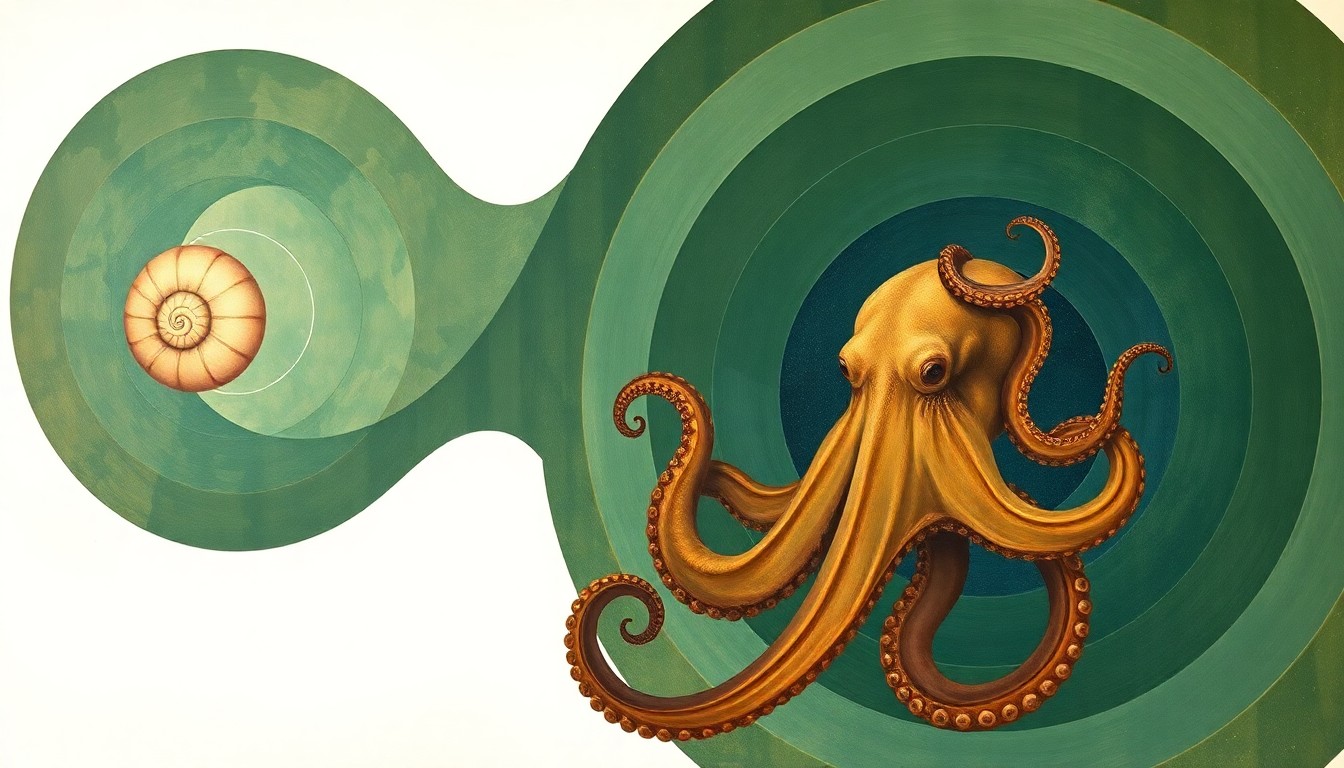 A scientific visualization of the evolutionary relationship between nautilus and octopus, as revealed by the reclassification of the ancient Pohlsepia fossil.Reading Today
A fossil once believed to be the world's oldest octopus has been reclassified as a relative of the nautilus, a multi-tentacled mollusk with an external shell. Researchers at the University of Reading used advanced synchrotron imaging to discover concealed teeth within the fossil, proving it was not an octopus as previously thought.
Why it matters
This discovery challenges our long-held understanding of cephalopod evolution, pushing back the origins of octopuses by over 150 million years. It highlights the importance of modern scientific techniques in rewriting the story of ancient life and demonstrates how even famous fossils can be misidentified without access to cutting-edge analysis.
The details
The fossil, known as Pohlsepia mazonensis, was believed to be the oldest octopus fossil at 296 million years old. However, the University of Reading team used synchrotron imaging to peer deep into the specimen, revealing a set of 11 teeth-like structures per row within its radula. This tooth count is inconsistent with octopuses, which have 7 or 9 teeth per row, and instead points to a closer relation to the nautilus, a living mollusk with an external shell.
- The fossil of Pohlsepia mazonensis dates back 300 million years.
- The fossil was originally classified as the world's oldest octopus in the 2000s.
The players
University of Reading
The university where the research team that reclassified the Pohlsepia mazonensis fossil is based.
Dr. Thomas Clements
A lecturer in invertebrate zoology at the University of Reading and the lead author of the study that reclassified the fossil.
What they’re saying
“It turns out the world's most famous octopus fossil was never an octopus at all. It was a nautilus relative that had been decomposing for weeks before it became buried and later preserved in rock, and that decomposition is what made it look so convincingly octopus-like.”
— Dr. Thomas Clements, Lecturer in Invertebrate Zoology, University of Reading
“It's amazing to think a row of tiny hidden teeth, hidden in the rock for 300 million years, have fundamentally changed what we know about when and how octopi evolved.”
— Dr. Thomas Clements, Lecturer in Invertebrate Zoology, University of Reading
What’s next
The reclassification of Pohlsepia mazonensis will likely spur further research into the evolution of cephalopods, as scientists work to piece together a more accurate timeline of when octopuses first appeared on Earth.
The takeaway
This discovery highlights the power of modern scientific techniques like synchrotron imaging to overturn long-held assumptions about the ancient past. It demonstrates the importance of critical thinking and a willingness to revise our understanding of the natural world as new evidence emerges.
Reading top stories



Reading events

Apr. 11, 2026
Reading Royals vs. Wheeling Nailers
Apr. 11, 2026
Almost Queen
Apr. 11, 2026
Reading Fightin Phils vs. Hartford Yard Goats