- Today
- Holidays
- Birthdays
- Reminders
- Cities
- Atlanta
- Austin
- Baltimore
- Berwyn
- Beverly Hills
- Birmingham
- Boston
- Brooklyn
- Buffalo
- Charlotte
- Chicago
- Cincinnati
- Cleveland
- Columbus
- Dallas
- Denver
- Detroit
- Fort Worth
- Houston
- Indianapolis
- Knoxville
- Las Vegas
- Los Angeles
- Louisville
- Madison
- Memphis
- Miami
- Milwaukee
- Minneapolis
- Nashville
- New Orleans
- New York
- Omaha
- Orlando
- Philadelphia
- Phoenix
- Pittsburgh
- Portland
- Raleigh
- Richmond
- Rutherford
- Sacramento
- Salt Lake City
- San Antonio
- San Diego
- San Francisco
- San Jose
- Seattle
- Tampa
- Tucson
- Washington
Rochester Hills Today
By the People, for the People
FANUC and NVIDIA Partner to Advance Physical AI in Industrial Robotics
The collaboration aims to enable more adaptive manufacturing environments through integrated AI computing and simulation technologies.
Apr. 9, 2026 at 5:04am
Got story updates? Submit your updates here. ›
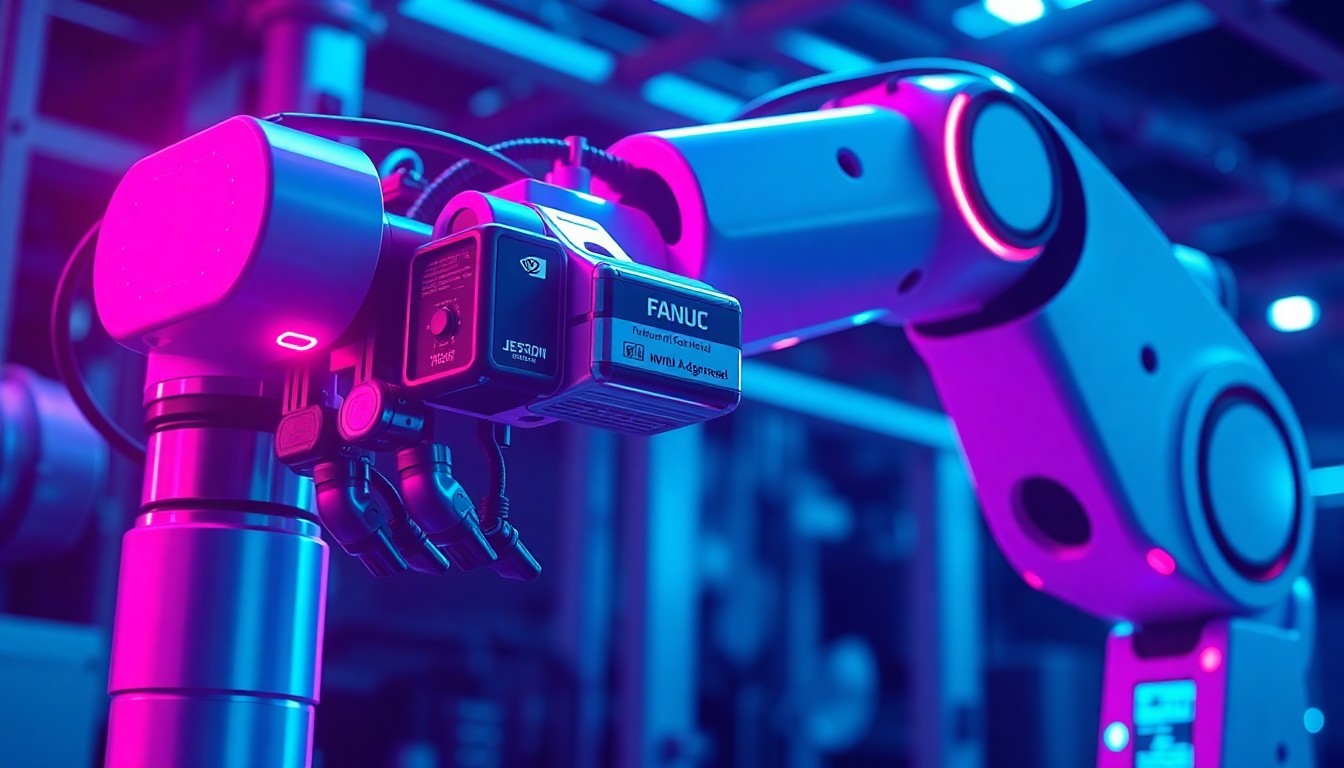 The partnership between FANUC and NVIDIA aims to bring the power of physical AI to the factory floor, enabling more adaptive and responsive industrial automation.Rochester Hills Today
FANUC America is collaborating with NVIDIA to advance the use of physical AI in industrial robotics, combining automation systems with AI computing and simulation technologies to support more adaptive manufacturing environments. The partnership focuses on integrating NVIDIA's AI infrastructure, including Jetson edge modules, simulation platforms and Omniverse libraries, into FANUC's robotics portfolio and ROBOGUIDE simulation software.
Why it matters
Physical AI represents a shift in how automation systems operate, moving beyond pre-programmed instructions to enable robots that can perceive their surroundings, make decisions and adjust to changing conditions on the factory floor. This collaboration aims to give manufacturers the tools to deploy intelligent robotics faster and better align virtual design with real-world production.
The details
Key components of the collaboration include the use of digital twin technology, where FANUC's ROBOGUIDE simulation software is integrated with NVIDIA Isaac Sim and Omniverse platforms to create virtual models of production lines, test workflows and optimize operations before deploying physical equipment. This approach allows companies to reduce commissioning time and cost while improving system performance. The collaboration also expands how robots are controlled and programmed, with FANUC applying NVIDIA AI technologies to enable robots to interpret voice commands and automatically generate Python code.
- The partnership was announced in April 2026.
The players
FANUC America
An industrial automation company that manufactures robots, CNC systems, and other factory automation products.
NVIDIA
A technology company known for its graphics processing units (GPUs) and AI computing platforms.
Mike Cicco
The president and CEO of FANUC America.
Murali Gopalakrishna
The general manager of robotics at NVIDIA.
What they’re saying
“Physical AI is the next frontier in industrial automation. By collaborating with NVIDIA, we're giving manufacturers the tools to deploy intelligent robotics faster and align virtual design with real-world production.”
— Mike Cicco, President and CEO, FANUC America
“Manufacturers are increasingly seeking physical AI solutions that bridge the gap between virtual simulation and real-world production to overcome labor shortages and increase operational efficiency.”
— Murali Gopalakrishna, General Manager of Robotics, NVIDIA
What’s next
FANUC plans to demonstrate the integrated AI and simulation capabilities at upcoming industry events, showcasing how the collaboration with NVIDIA can help manufacturers deploy more adaptive and responsive automation systems.
The takeaway
This partnership between FANUC and NVIDIA represents a significant advancement in the integration of AI and simulation technologies into industrial robotics. By bridging the gap between virtual design and real-world production, manufacturers can unlock new levels of flexibility, efficiency and responsiveness in their automation systems, helping them overcome labor shortages and adapt to changing market demands.