- Today
- Holidays
- Birthdays
- Reminders
- Cities
- Atlanta
- Austin
- Baltimore
- Berwyn
- Beverly Hills
- Birmingham
- Boston
- Brooklyn
- Buffalo
- Charlotte
- Chicago
- Cincinnati
- Cleveland
- Columbus
- Dallas
- Denver
- Detroit
- Fort Worth
- Houston
- Indianapolis
- Knoxville
- Las Vegas
- Los Angeles
- Louisville
- Madison
- Memphis
- Miami
- Milwaukee
- Minneapolis
- Nashville
- New Orleans
- New York
- Omaha
- Orlando
- Philadelphia
- Phoenix
- Pittsburgh
- Portland
- Raleigh
- Richmond
- Rutherford
- Sacramento
- Salt Lake City
- San Antonio
- San Diego
- San Francisco
- San Jose
- Seattle
- Tampa
- Tucson
- Washington
Silver Spring Today
By the People, for the People
College Students Grapple with Morality of War Amid Trump's Iran Taunts
As tensions escalate, students studying peace and conflict find Trump's social media threats at odds with just war theory.
Apr. 11, 2026 at 2:33pm
Got story updates? Submit your updates here. ›
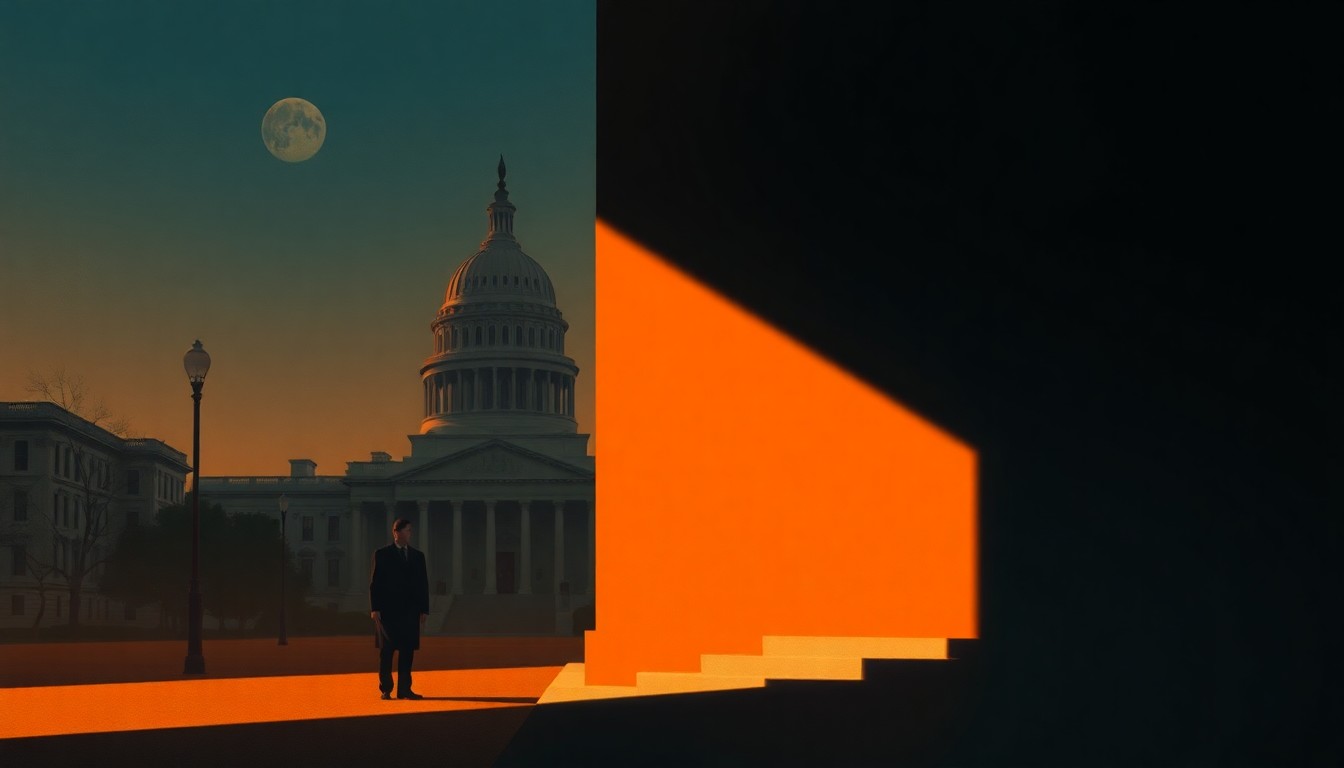 As tensions over the conduct of modern warfare escalate, a pensive political figure stands alone in the shadows, underscoring the moral complexities that students must grapple with.Silver Spring Today
In the wake of President Trump's controversial social media post threatening to 'level' Iranian civilization, college students studying peace and conflict are wrestling with how his rhetoric compares to the moral frameworks they've learned, including just war theory. Professors are guiding discussions on the legal definitions of war, the principles of just intention and discrimination, and how new technologies can enable the 'language of violence and disinformation' to erode deeply held norms. While some students feel numb to the constant barrage of global crises, many are hungry for moral structure and eager to engage in activism around these issues.
Why it matters
Trump's casual threat to destroy an entire Iranian civilization, made via social media, highlights the growing disconnect between the realities of modern warfare and the moral and legal principles that have historically governed the conduct of war. As a new generation of students grapples with these complex issues, it underscores the need to reconcile evolving geopolitical dynamics with enduring ethical frameworks.
The details
In a class on peace studies at Catholic University, professor Maryann Cusimano Love led discussions on how Trump's tweet comparing the potential destruction of Iran to 'a whole civilization will die tonight' violated principles of just war theory, such as the prohibitions on indiscriminate attacks and genocide. Students analyzed how Trump's rhetoric dehumanized Iranians and compared it to historical examples of leaders using new technologies to incite violence. At Tufts University, a philosophy class grappled with the moral implications of civilian casualties, even as the Trump administration has taken actions that would be 'under no circumstance ever be morally permissible' under just war theory. And at Christendom College, a political theory class agreed that Trump's threatening post violated just war principles, with no one expressing sympathy for it.
- On Tuesday, April 11, 2026, Trump posted the controversial tweet about destroying Iranian civilization.
- Classes at colleges and universities around the country tackled the moral and legal implications of Trump's approach that week.
The players
Maryann Cusimano Love
Chair of the Politics Department at Catholic University and a consultant for the Vatican on issues of nuclear and artificial intelligence weapons.
Sophia Flores Sanchez
A 21-year-old politics major from Silver Spring, Maryland, who attends Catholic University.
Kevin McElligott
A 21-year-old sophomore studying politics and history at Catholic University, from Simsbury, Connecticut.
Sean Matthews
A 20-year-old student of politics and global studies at Catholic University, from Massachusetts.
Aidan Connors
A 22-year-old philosophy and theatrical performance double major at Tufts University who will graduate this spring and plans to go to law school.
What they’re saying
“A whole civilization will die tonight, never to be brought back again. I don't want that to happen, but it probably will.”
— Donald Trump, President of the United States
“On the tweet, it's like teetering on a point of no discrimination. He generalizes and says 'We're going to destroy civilization' - that's genocide. It's very dehumanizing.”
— Sophia Flores Sanchez, Politics Major
“Under all of the theories that we're reading, that would under no circumstance ever be morally permissible, but it's happening in real time.”
— Aidan Connors, Philosophy and Theatrical Performance Major
“You can't threaten to do something like that under just war. You can't threaten to commit a war crime as a negotiating tactic, even if you didn't mean it.”
— Bracy Bersnak, Political Theorist
“To get people to violate these deeply held moral norms that are deeply internalized, you have to take these actions. This is a real challenge, the way new technologies and AI can generate the language of violence and disinformation.”
— Maryann Cusimano Love, Politics Professor
What’s next
The fragile U.S.-Iran ceasefire remains in place, but the questions of morality and war sparked by Trump's controversial tweet will continue to be debated in classrooms across the country.
The takeaway
Trump's casual threat to destroy an entire Iranian civilization highlights the growing disconnect between the realities of modern warfare and the moral and legal principles that have historically governed the conduct of war. As a new generation of students grapples with these complex issues, it underscores the need to reconcile evolving geopolitical dynamics with enduring ethical frameworks in order to uphold the principles of just war and prevent the erosion of deeply held moral norms.
Silver Spring top stories


Silver Spring events

Apr. 12, 2026
DaBaby
Apr. 14, 2026
Helloween: 40th Anniversary North American Tour 2026