- Today
- Holidays
- Birthdays
- Reminders
- Cities
- Atlanta
- Austin
- Baltimore
- Berwyn
- Beverly Hills
- Birmingham
- Boston
- Brooklyn
- Buffalo
- Charlotte
- Chicago
- Cincinnati
- Cleveland
- Columbus
- Dallas
- Denver
- Detroit
- Fort Worth
- Houston
- Indianapolis
- Knoxville
- Las Vegas
- Los Angeles
- Louisville
- Madison
- Memphis
- Miami
- Milwaukee
- Minneapolis
- Nashville
- New Orleans
- New York
- Omaha
- Orlando
- Philadelphia
- Phoenix
- Pittsburgh
- Portland
- Raleigh
- Richmond
- Rutherford
- Sacramento
- Salt Lake City
- San Antonio
- San Diego
- San Francisco
- San Jose
- Seattle
- Tampa
- Tucson
- Washington
Mazon Today
By the People, for the People
Fossil Reveals Octopus Ancestor Was Actually a Nautiloid
New synchrotron imaging technology uncovers surprising truth about the earliest known cephalopod fossil
Apr. 11, 2026 at 10:40pm
Got story updates? Submit your updates here. ›
 The reclassification of an ancient fossil challenges our understanding of octopus evolution, revealing the dynamic nature of scientific discovery.Mazon Today
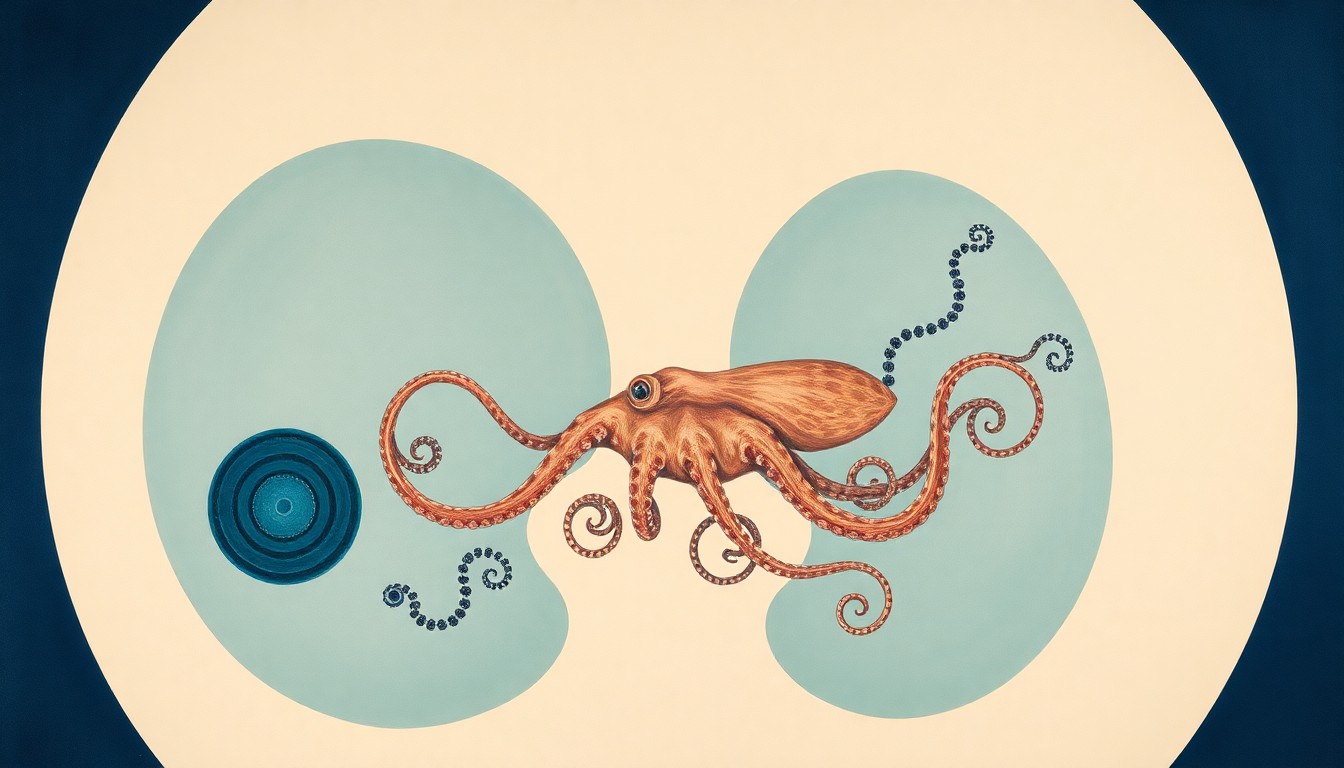
A fossil long believed to be the earliest known octopus has been reinterpreted as actually belonging to a nautiloid, an ancient ten-armed cephalopod, thanks to advanced synchrotron imaging technology that revealed the presence of teeth characteristic of nautiloids rather than octopuses. This finding pushes back the timeline for when the octopus lineage diverged from its nautiloid ancestors, suggesting a more gradual evolutionary process than previously thought.
Why it matters
The reclassification of this fossil challenges the established timeline for octopus evolution, forcing scientists to reevaluate their understanding of how these enigmatic invertebrates diversified over deep time. It highlights the power of new technologies to continuously refine our knowledge of the past and underscores the dynamic, ever-evolving nature of paleontological discovery.
The details
The fossil in question was first analyzed in 2000 and initially identified as the earliest known octopus, based on its apparent eight-armed morphology. However, when researchers recently used synchrotron imaging to examine the fossil in greater detail, they discovered the presence of teeth that are characteristic of nautiloids, a group of ten-armed cephalopods that are evolutionarily older than octopuses. This unexpected finding suggests the fossil is not an octopus at all, but rather a nautiloid, forcing scientists to rethink the timeline of octopus evolution.
- The fossil was first analyzed and identified as an octopus in 2000.
- The new synchrotron imaging analysis that revealed the nautiloid teeth was conducted recently.
The players
Mazon Creek lagerstätte
A famous fossil-rich geological site in Illinois where the octopus-turned-nautiloid fossil was originally unearthed.
Synchrotron imaging
A highly advanced X-ray technology that uses an extremely bright beam of light to reveal fine details hidden within rock, enabling the reinterpretation of the fossil.
What they’re saying
“It's a story that, frankly, tickles my paleontological funny bone.”
— The author
“This nautiloid-turned-octopus, and then back again, serves as a brilliant case study in that very process. It reminds us that our interpretations are only as good as the tools and data we have at hand.”
— The author
What’s next
The implications of this fossil reclassification will likely spur further research into the evolutionary relationships and divergence timelines of cephalopod lineages, as scientists work to refine our understanding of these enigmatic creatures.
The takeaway
This discovery highlights the dynamic nature of scientific inquiry, where new technologies and evidence can continuously reshape our understanding of the past. It serves as a reminder that the fossil record is an ever-evolving tapestry, and that the stories it tells are constantly being rewritten through the persistent curiosity and ingenuity of paleontologists.