- Today
- Holidays
- Birthdays
- Reminders
- Cities
- Atlanta
- Austin
- Baltimore
- Berwyn
- Beverly Hills
- Birmingham
- Boston
- Brooklyn
- Buffalo
- Charlotte
- Chicago
- Cincinnati
- Cleveland
- Columbus
- Dallas
- Denver
- Detroit
- Fort Worth
- Houston
- Indianapolis
- Knoxville
- Las Vegas
- Los Angeles
- Louisville
- Madison
- Memphis
- Miami
- Milwaukee
- Minneapolis
- Nashville
- New Orleans
- New York
- Omaha
- Orlando
- Philadelphia
- Phoenix
- Pittsburgh
- Portland
- Raleigh
- Richmond
- Rutherford
- Sacramento
- Salt Lake City
- San Antonio
- San Diego
- San Francisco
- San Jose
- Seattle
- Tampa
- Tucson
- Washington
Mazon Today
By the People, for the People
Fossil Reexamination Upends Octopus Origin Story
New synchrotron imaging reveals Mazon Creek specimen is not an ancient octopus after all.
Apr. 10, 2026 at 3:07am
Got story updates? Submit your updates here. ›
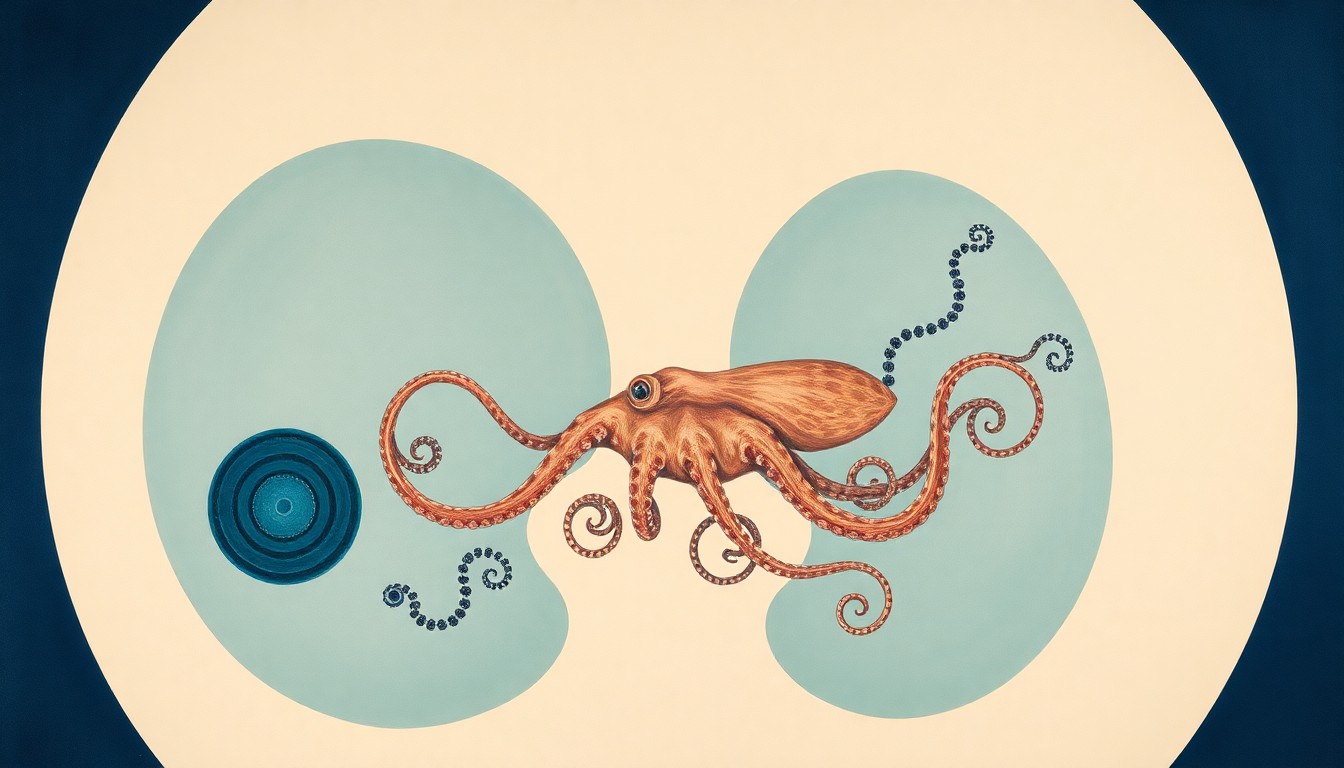
 The revised timeline of cephalopod evolution, as new evidence challenges long-held assumptions about the origins of the octopus lineage.Mazon Today
A fossil long believed to be one of the earliest known octopuses has been reexamined using advanced synchrotron imaging technology, revealing that the specimen is not an octopus at all. The fossil, found in the Mazon Creek fossil beds in Illinois, was initially described in 2000 as an eight-armed cephalopod, but the new analysis shows it is actually the remains of a different type of predator, likely a nautiloid. This finding significantly reshapes the timeline of octopus evolution, pushing the origins of the modern octopus lineage forward by hundreds of millions of years.
Why it matters
This discovery challenges a long-standing understanding of when octopuses first appeared in the fossil record and how their evolutionary history unfolded. It demonstrates the importance of revisiting old fossils with new technologies, as well as the provisional nature of scientific narratives that can be reshaped by better evidence and sharper questions.
The details
The Mazon Creek fossil, found in a treasure trove of ancient life preserved in siderite concretions, was initially hailed in 2000 as one of the earliest known octopuses, with eight presumed arms and other soft-tissue features reminiscent of modern cephalopods. However, when scientists rescanned the fossil using synchrotron imaging, a technology that uses extremely bright X-ray beams to peer into rock, the hidden details told a different story. Rather than the eight-armed silhouette of an octopus, the new analysis revealed the teeth and ceramic-like markers of a simpler, more enigmatic predator that shared the site with a nautiloid fossil. In other words, what was thought to be an ancient octopus was actually a mix of different organisms or misattributed features due to the fossil's preservation.
- In 2000, researchers announced the discovery of what seemed to be a clear octopus fossil from the Mazon Creek site.
- In the mid-2020s, scientists used synchrotron imaging to rescan the Mazon Creek fossil, revealing its true nature as the remains of a different type of predator, likely a nautiloid.
The players
Mazon Creek
A fossil-rich site in Illinois that has yielded a diverse array of ancient life preserved in siderite concretions.
Synchrotron imaging
A technology that uses extremely bright X-ray beams to peer into rock and reveal hidden details with astonishing clarity, allowing scientists to reexamine old fossils.
What’s next
The revised timeline for octopus evolution will need to be further investigated and validated through additional fossil discoveries and analyses using advanced imaging techniques.
The takeaway
This case study highlights the importance of revisiting old fossils with new technologies, as well as the provisional nature of scientific narratives. It demonstrates how breakthroughs in one field, such as imaging technology, can significantly reshape our understanding of evolutionary history and the pace of change in the natural world.