- Today
- Holidays
- Birthdays
- Reminders
- Cities
- Atlanta
- Austin
- Baltimore
- Berwyn
- Beverly Hills
- Birmingham
- Boston
- Brooklyn
- Buffalo
- Charlotte
- Chicago
- Cincinnati
- Cleveland
- Columbus
- Dallas
- Denver
- Detroit
- Fort Worth
- Houston
- Indianapolis
- Knoxville
- Las Vegas
- Los Angeles
- Louisville
- Madison
- Memphis
- Miami
- Milwaukee
- Minneapolis
- Nashville
- New Orleans
- New York
- Omaha
- Orlando
- Philadelphia
- Phoenix
- Pittsburgh
- Portland
- Raleigh
- Richmond
- Rutherford
- Sacramento
- Salt Lake City
- San Antonio
- San Diego
- San Francisco
- San Jose
- Seattle
- Tampa
- Tucson
- Washington
Farmer City Today
By the People, for the People
Herpes Virus Softens Cell Nuclei in Breakthrough Discovery
Cutting-edge research reveals how DNA viruses actively remodel nuclear biomechanics
Apr. 11, 2026 at 6:07am
Got story updates? Submit your updates here. ›
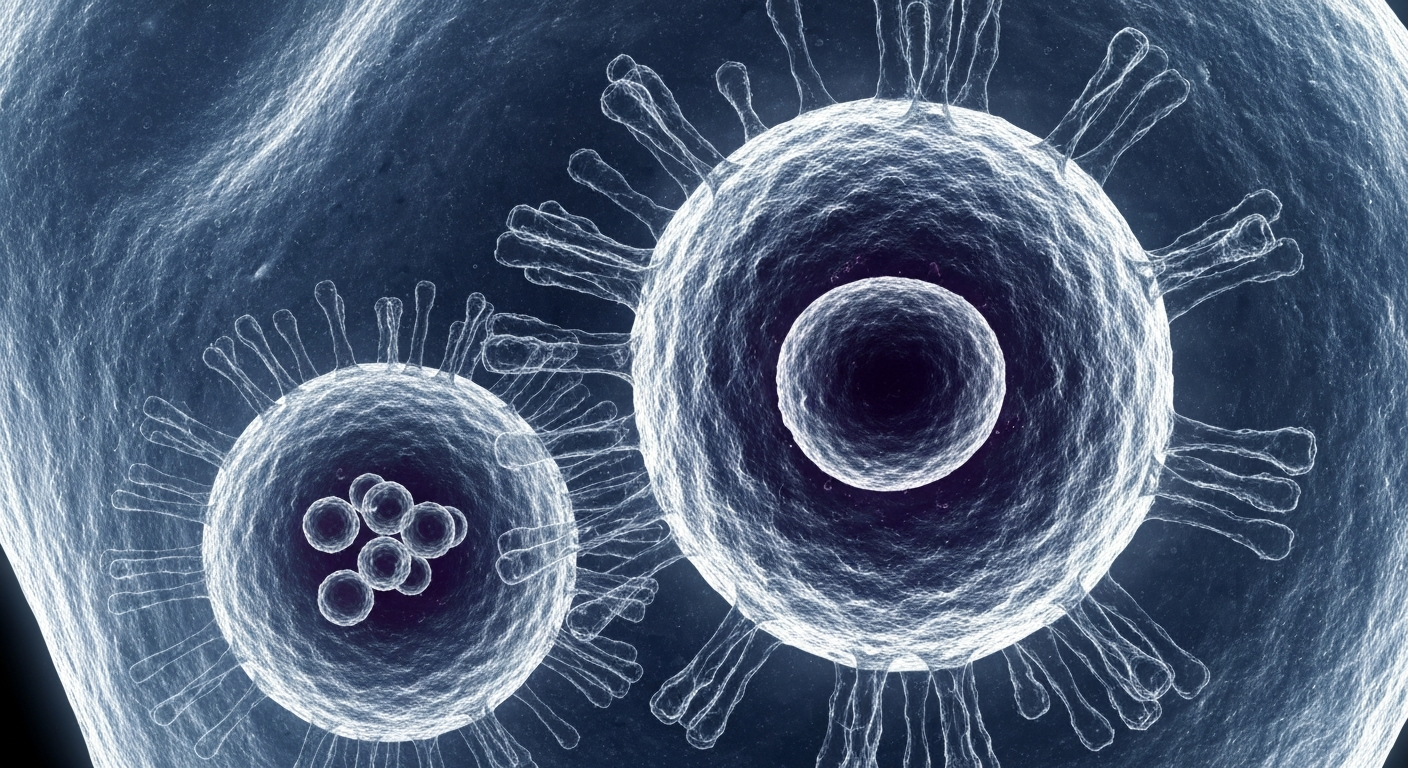 An X-ray view into the hidden world of viral infection, where the Herpes simplex virus softens the nucleus of its host cell to facilitate replication.Farmer City Today
An international research team has uncovered the mechanism behind the softening of cell nuclei during herpes virus infection. Using advanced microscopy and computational modeling, scientists found that the Herpes simplex virus 1 (HSV-1) induces dramatic structural changes within the host cell nucleus, challenging our understanding of the forces acting on cells.
Why it matters
This discovery not only sheds light on virus-induced nuclear remodeling, but also opens up possibilities for early diagnosis and more effective strategies to combat viral infections and their impact on cellular health.
The details
The study, led by researchers at the University of Jyväskylä in Finland, found that HSV-1 infection leads to the emergence of enlarged, low-density viral replication compartments within the nucleus, causing significant changes in nuclear volume, chromatin organization, and the structure of the nuclear lamina. Surprisingly, the softening of the nucleus is an active remodeling process, rather than a passive one, challenging the understanding of the forces acting on cells.
- The study was published in the journal PLOS Pathogens in April 2026.
The players
Maija Vihinen-Ranta
Research Director at the University of Jyväskylä, who emphasizes the significance of this discovery.
What they’re saying
“Our mechanical simulations and in vitro experiments showed that a reduction in outward forces is the most likely factor in nuclear softening.”
— Maija Vihinen-Ranta, Research Director, University of Jyväskylä
What’s next
The findings from this study could lead to the development of more effective strategies to combat viral infections and their impact on cellular health.
The takeaway
This breakthrough discovery not only advances our understanding of virus-cell interactions, but also opens up new possibilities for early diagnosis and targeted interventions against viral infections that compromise cellular integrity.