- Today
- Holidays
- Birthdays
- Reminders
- Cities
- Atlanta
- Austin
- Baltimore
- Berwyn
- Beverly Hills
- Birmingham
- Boston
- Brooklyn
- Buffalo
- Charlotte
- Chicago
- Cincinnati
- Cleveland
- Columbus
- Dallas
- Denver
- Detroit
- Fort Worth
- Houston
- Indianapolis
- Knoxville
- Las Vegas
- Los Angeles
- Louisville
- Madison
- Memphis
- Miami
- Milwaukee
- Minneapolis
- Nashville
- New Orleans
- New York
- Omaha
- Orlando
- Philadelphia
- Phoenix
- Pittsburgh
- Portland
- Raleigh
- Richmond
- Rutherford
- Sacramento
- Salt Lake City
- San Antonio
- San Diego
- San Francisco
- San Jose
- Seattle
- Tampa
- Tucson
- Washington
Pigeons Operate 'At Edge Of Chaos,' Study Reveals
Researchers find pigeons maintain behavioral flexibility even when rewarded for repetitive patterns.
Apr. 7, 2026 at 3:02am
Got story updates? Submit your updates here. ›
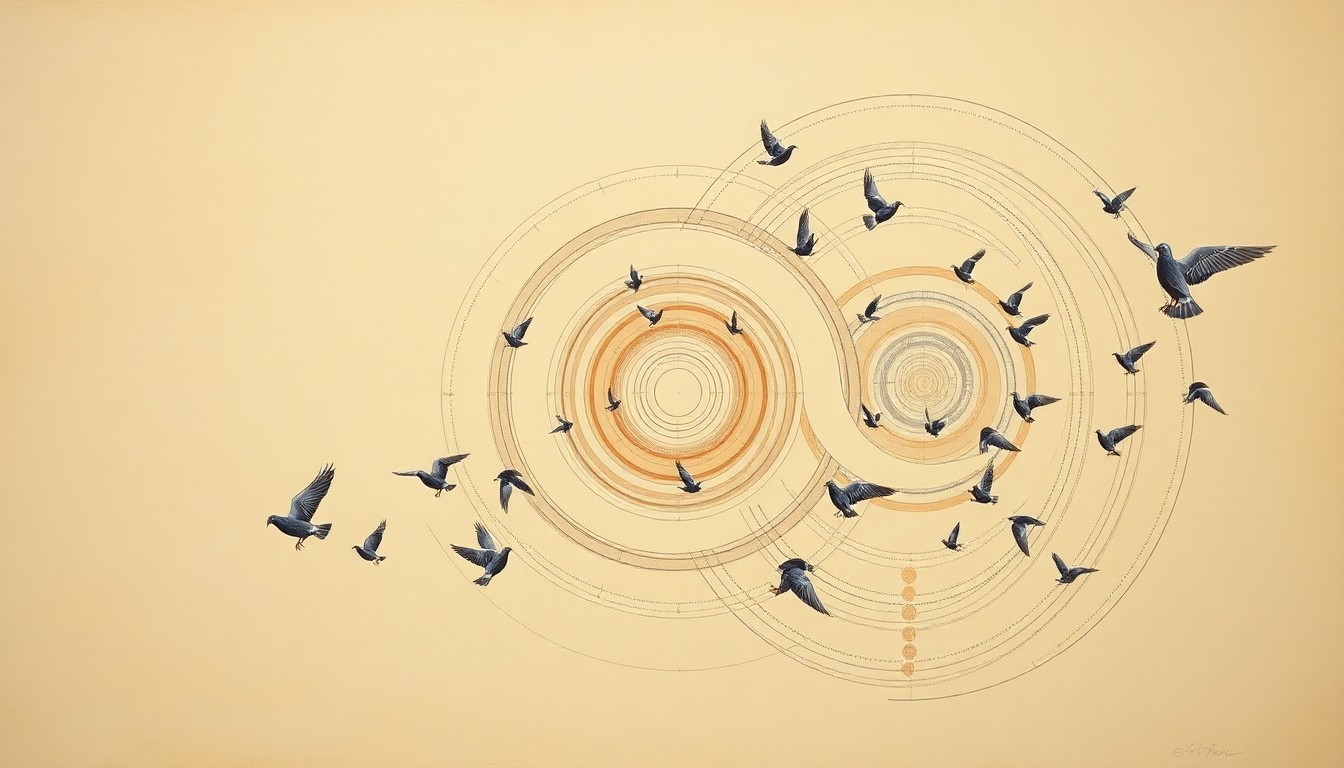 A conceptual illustration of the 'edge of chaos' behavioral patterns exhibited by pigeons in a groundbreaking University of Iowa study.Iowa City Today
A new study from the University of Iowa reveals that pigeons exhibit a unique pattern of behavior, maintaining variability in their actions even when rewarded for repeating a specific sequence. The researchers found that the birds never fully committed to a single preferred sequence, instead continuing to explore multiple options in what they describe as 'responding at the edge of chaos'.
Why it matters
The findings challenge the long-held 'Law of Effect' which suggests animals will repeat rewarded behaviors and reduce their range of options. This study extends the concept of 'the edge of chaos' beyond evolutionary biology, suggesting that flexible, innovative behaviors in animals and humans may involve a similar adaptive variation.
The details
In the experiment, pigeons were rewarded with food for pecking a sequence of 5 buttons in any order. While the birds did start to favor certain sequences, they never fully committed to a single pattern and continued to explore alternative options throughout the 8-month, 30,000-trial study. The researchers say this 'dramatic behavioral instability' defies the traditional 'Law of Effect' and shows the pigeons maintain an 'exploratory tendency' rather than simply sticking to what works.
- The study was published online on April 6, 2026 in the Journal of Experimental Psychology: Animal Learning and Cognition.
- The research was conducted over an 8-month period, with the pigeons performing the task 30,000 times.
The players
Ed Wasserman
Professor in the Department of Psychological and Brain Sciences at the University of Iowa and the study's corresponding author.
Odysseus Orr
Third-year graduate student in the Department of Psychological and Brain Sciences at the University of Iowa and study co-author.
Sophia Li
Study co-author.
University of Iowa
The institution where the research was conducted.
What they’re saying
“What we learned is there's something that keeps the birds from becoming fully machinelike in their responses. Maybe it's in their best interest to keep some variability in their behavior. You don't want to be too locked in, because things happen, and the world could change.”
— Ed Wasserman, Professor, Department of Psychological and Brain Sciences
“Might other, more intricate and innovative behaviors like playing an instrument, composing music, and creating visual art involve similarly adaptive variation? Only time will tell, but the pigeons provide a convenient gateway for answering those questions under highly controlled circumstances.”
— Odysseus Orr, Graduate Student, Department of Psychological and Brain Sciences
What’s next
The researchers plan to further explore the concept of 'the edge of chaos' and how it may apply to more complex behaviors in both animals and humans.
The takeaway
This study challenges long-held assumptions about animal behavior, suggesting that even simple creatures like pigeons maintain a degree of behavioral flexibility that allows them to adapt to changing circumstances. The findings open new avenues of research into the nature of cognition and innovation.